The Dream Job

I had a strange dream last night. It may have been the take-out food, laying heavy in my stomach or it may have been the election season, weighing heavy on my soul.

In the dream, I was driving along a road. It was not a new road; it was rough but it was serviceable. The road was running by the side of a vast construction project; the beginnings of a bridge I thought to myself. The project lay in the middle of a rolling sandy riverbed with a small but growing stream meandering down the middle. It had been the dry season but now it was raining and the stream had turned to a river and the river was building towards a serpentine flood.

The site was abandoned except for two guys in waders working under a pile cap; the thick concrete slab sitting on top of the driven piles that together provide the structural support required for any building that’s meant to last. They were bracing the formwork and getting ready to pump concrete. The one was supporting a heavy timber with his shoulder while the other was securing it with hammer and spike. They were chest deep in water that was swirling with sand; as if they were standing in the middle of a concrete pour themselves. The spot they were working was tight; their bodies were hunched but they were getting the job done.

They couldn’t see that waves of water were heading towards them but I knew they didn’t care. The job had to be finished. I know that feeling. I’ve been in that moment. I’ve been on that kind of job. It is a situation where pride and necessity and sacrifice are braided together.

This is who we are. This is what we do. There is no time for later.

My friend and fellow Dockbuilder, John McCrudden, has just finished burying his father after a years long illness. It wasn’t easy. His father was a time traveler. John texted me not long ago and our exchange went like this.

John- “My dad is reading the paper to me but I think he’s making it up.”

Me-  “What makes you think so?”

John- “Germany just annexed the Sudetenland.”

Me- “Again?”

John- “No, this is the first time according to him,”

Me- “I see. Still, I was a believer right up until that “First Time” thing.”

John- “Germany just invaded Poland. More to come.”

Within days of his father’s funeral, his father-in-law became gravely ill. His sister was recently diagnosed with cancer.

As John might say: “My plate is full but there’s nothing good to eat.”

John has met this wall of abrasive water. It has been relentless and wearing but his resolve is firm. He has waded in, taken hold of the bucking, angry python that is a concrete hose, and done what needed to be done. He is driven by need and guilt and faith and responsibility and honor. All the things that drive the best in us.

John has been a great support to me as I deal with my own father’s infirmities. I can only hope that my friendship is of a comparable quality. I think it is. I think we are together under that pile cap and its threatening load. That is why, in this business, we never work alone. We always work together because to build this bridge, to make this crossing successfully, requires more hands than any one person has and more skills than any one person can master.

The Art Opening

Sculpture: Tom Butter

I went to a friend’s art opening the other night. I entered the building, stopped to check the directory to locate the gallery and turned to find my pal Tom standing right behind me. That’s a good sign since a trip to a gallery where I don’t know anyone is usually brief and depressing. Brief because I don’t much care for looking at new art and depressing because artists are, as a rule, terrible conversationalists. Artists don’t talk so much as they give a point by point recitation of their resume. It’s a transparently self-centered exercise and unforgivably dull. The only upside is that invariably these people’s egos are as fragile as the thin film of burnt sugar on a creme brûlée. It’s a combination that fairly demands a little soft tissue probing. Torturing artists can be fun but it’s so easy it barely qualifies as sporting.

Tom thinks that I’m macho because I’m in heavy construction as well as the fine arts. In fact, a lot of people seem to think I get a lot done for someone with three kids, a full time job and a so called career in the arts but Tom genuinely seems to be impressed by it. Maybe he’s just shy and it gives him something to talk about. We are friendly now and there is a real warmth, but that was not always the case.

Tom is a sculptor I met back in my Philly days. I worked in art galleries as a preparator, which sounds like a salad position in a restaurant but is more like a salad position in a gallery. You know, hang the work, paint the walls, date the receptionist, that sort of thing. Back then, Tom was one of the few artists whose work I could really identify with. He lived in New York and was in a good gallery and he taught and was good looking and super talented and he has a great last name; Butter. Tom Butter. How can a name like that not shine? It’s inevitable. Like an unfair advantage. Tom was also mysterious and ultra-smart. For me, he was an artist to be like. Not that I wanted to make his work, or have his life, but I wanted to be a respected artist with important things to say, a good gallery in Manhattan, an exotic girlfriend and a great name. Man, then I would have it all. Back then it didn’t seem like too much to ask, it just seemed so far away. Except the name. That! That was too much to ask.

I felt back then that a good first step would be to befriend this guy. It wasn’t a strategic move, it was simply that I wanted his approval. Like many young people and not so young people for that matter, I sought the approval of those I respected who were in a position of authority. I guess that’s normal and certainly beats seeking the approval of those whom no one respects and have no authority at all. Better to aim a little higher, I say.

Well naturally I didn’t get his approval which should come as no surprise. I, and almost everyone else, always look for approval from those who won’t give it. Which is probably just as well. Where is the value of something that is given away for free? I was forced to admit that, unfortunately, this was going to require some work. If I wanted respect, I was going to have to earn it. In fact, I was never able to find a way to talk to Tom at all. I’m sure I was awkward but I also think he was a bit tightly wound.

Years later, after I moved to New York, I would run into Tom every so often at his art openings or at Parsons School of Design where I worked as a technician at night and he taught during the day. It was always the same. A simple hello; totally ungratifying. Even more so because he was so animated with his students. Eventually it dawned on me that he was comfortable in a position of authority like the student teacher relationship. All I needed was to put myself in that position. In other words, all I really needed was a question.

By this point I was more grown up and beyond caring about the approval of others. Age and the daily abuses of heavy construction had pretty much cured me of that, but Tom was a loose end from my youth. My desire to connect with him had lost its sense of urgency and need; it was now more like a hobby.

Around this time, it so happens, I was working on my own show. It was my third solo exhibition and I was trying hard to grow the work around a tightly focused idea. I always underpin my work with a ton of research and in this instance I was meddling in art history. History is a place I have an interest in but I probably shouldn’t be allowed to go. I have a terrible memory and I’m not a stickler for facts, even when I know them. I had been doing research on the mathematics of Postwar American Art. There has never been a period of such raw experimentation with such astounding successes and yet that aesthetic passed away like all the others before it.

To me it was a mystery and I thought if I revisited some of the more formal tactics used by the greats I might learn something. Maybe some of that greatness would rub off on me.

I was using everything from John Cage’s chance operations and Myron Stout’s handmade, obsessive precision to Barnett Newman’s personal preferences for canvas size. From the standard intervals of Donald Judd to the variable intervals of subway stops on the A Train between West 4th and 125th street, I used it all.

I couldn’t see it then but I realize now that these names were the superheroes of my youth. I did not read comic books until I was in my twenties when I stopped watching television. But as a kid I would always look through the picture books in our house and, my father being an artist, all the picture books were contemporary art books; all the magazines were art magazines.

I was trying to tether my work to this most explosive period of American Art when I ran into Tom at school. I cornered him, if it can be said that someone can be cornered in the middle of a hallway, and shot him the question that I’d been rolling over in my mind and which doesn’t seem to be answered in any book. It is also the question which I had formulated for just this occasion. The only other question on my mind was: “Will he take the bait?”

As any fisherman will tell you; when you go fishing it is important to know your prey and to use the right bait. The right bait on the wrong hook will not get you dinner. The wrong lure in the right place will leave you hungry. But if the lure is convincing and the fish is provoked and you are quiet, all that remains is patience. I am a patient man.

Hey Tom,

What was the failure of modernism?

.

.

.

.

.

.

Jackpot!

The Good Book

There are some books that you want to read. There are some books that you have to read. And there are some books that are ill-fitting shoes; you try to get into them but there’s just too much resistance and they are set aside. And then there are the classics. Books that can be read again and again with something new taken away at each reading.

It’s been awhile since I dove into a classic so I thought I’d go straight to a book that pretty much everyone is familiar with. Anyone stressed out from a cross-country road trip will find a copy in their motel room. It is there to calm, and to soothe, and to inform. In fact, in one form or another, it’s probably the most read book out there. I am, of course, referring to the phone book.

I am a purist so I prefer the White Pages but for raw excitement I will occasional succumb to the cheap thrills of the Yellow Pages. Illustrations, bold type, extravagant claims; it can be a little overwhelming. All flash; very Hollywood.

No, for me it’s the small label, indie film charm, of the White Pages. Visually calm but with the promise of discovery ’round every turn of the page. Did you ever take a strong magnifying glass to the beach and look at sand? Do! You’ll be surprised. The White Pages is like that. It is the map and the treasure; X marks the spot but so does every other letter. In fact, in my phone book, X is represented by a phone number and a single X. No first name or initial; no address. Very mysterious.

The phone book is like that; there is history, mystery and romance.

The phone book I’m reading is, I believe, a classic in its own right. The September 1998 to August 1999 Bell Atlantic White Pages for Brooklyn; Area Code 718, complete with six pages of CUSTOMER RIGHTS AND RESPONSIBILITIES (their caps not mine). The very first line reads “The last thing we want to do is turn off your telephone service.” You see? From the very first line you are in its grip. Hold that up to your “Call me Ishmael.” This is a threat! To you personally! And it’s real!

In reality, almost every phone book can be considered a classic. The hidden gem of a small, exclusive hotel, shares so much with the boutique qualities of a small town phone book. Those books are a history lesson in geography and the migration of people’s. Rural Minnesota books full of Anderson’s and Andersen’s; the French and Scottish surnames of Coastal Maine. And every book has its standouts. I am reminded of a mid-70’s Philadelphia White Pages of my youth. It takes me back just thinking about that manuscript; the leaves unbleached, thin as rolling papers. Maybe it’s hometown pride but that book had what I consider to be two of the finest entries anywhere. Phillip and Douglas Updegrave. Yes, you read that correctly. Phil Updegrave and Doug Updegrave. What a great family legacy. And these names would have been unavailable to the world at large were it not for being documented in the White Pages.

But for sheer variety it’s hard to beat Brooklyn. The Brooklyn book has a nice balance of names both familiar and unfamiliar. Sure, Queens is the most ethnically diverse place on the planet but when they say a fat man has more chins than a Chinese phonebook it’s just a joke; a little word play. Take it from me, there are way, way, way more Chin’s in the Chinese phonebook. The Chinese phone book is the king of the Chin’s but the Queens phone book has got to be running a close second.

Reading from the Queens book is like reading from a book in a language you don’t understand. In fact, it is reading from a book in a language you don’t understand. The Queens phone book is page after page of what look like menu items. A few hundred thousand names that are obviously phonetic spellings, transposed from alphabets that don’t contain any familiar letters. These names are wonderful I’m sure, but for a westerner they are sound without meaning; they don’t connect to anything. There are no narratives to build around them; they don’t remind you of anyone you might know or even know of. Bottom line? It kills the book’s dramatic tension. So Brooklyn, as in so many other spheres, is the place.

In place of all those Chin’s, Brooklyn has the Smith’s. The nice thing about the Smith’s is that everyone knows them.  They are America’s default next-door neighbor. You would think that Smith was the most common, English speaking, last name and there are a bunch of historical reasons that it is but in this Brooklyn book they are outnumbered by the Williams’, unless you count variations like Smythe, Schmidt and Kowalski, which is Polish for Smith.

With the big entries like Smith, Johnson, Brown, Williams and Jones, I like to see if the first names are represented by every letter in the alphabet. Sadly, Johnson and Williams are each missing an X. It’s always an X isn’t it. There’s always something getting in the way of perfection and it’s always something like an X; an element that seems deliberately inserted to foil a flawless performance. One more reminder that nothing worth doing comes easily.

The nice thing about reading the phone book is that you really can start anywhere. The story is timeless and familiar, the characters like old friends. Oh look! There’s John McCrudden. He actually is an old friend. The only Dockbuilder I know who can do justice to song after song from the golden age of Broadway musicals. Oklahoma, The Music Man, South Pacific, West Side Story; his “I Feel Pretty” will bring you to tears. In fact, it isn’t him at all. My John doesn’t even live in this state but you see it doesn’t matter. The connection is made.

No two people read the phone book the same way. Without guile, the telephone book interacts with you. The White Pages would never presume to leverage your affections. It is happy to let you write the story; you create the narrative. You see? Here is Daniel Walker. Daniel Walker was my first friend. He died and yet here he is. It’s good to see him. It brings back memories.

Plotnick, Plotnick, let’s see Barbara, no; David, no; Elizabeth, no; Seymour, no; aha! Walter! Walter Plotnick and I each had a broken arm in first grade. His was left, mine was right. It must be getting on 40 years since I last saw Walter and here he is. Not really though, but maybe. I live in a different city than the city whose suburbs I grew up in. It’s unlikely that this is the same Walter but that’s the beauty of the phone book. Everyone you know or ever knew, including fictional characters, is likely to be here but not if you don’t want them to be. All the names of old enemies belong to someone else. Their names have been diluted to the point of anonymity. Or not. Your choice.

Even though you can start reading the Phone Book anywhere, it’s only natural to start by having a look for your own name. You know, see if there are any others of you roaming around out there. I imagine it’s a strange feeling to see your name in a phone book and know it’s not you. Like there’s another you; a you who may be living one of the lives you misplaced along the way.

Then a review of those who share your last name. I have an unusual last name but there are other Mednick’s out there and though I doubt we’re related, they feel like lost family members when I read their names. It’s reminiscent of when you see old photographs of relatives who died before you were born.

The adolescent in me had to look up Lipschitz but who knew that I would be rewarded with a Lipshits? Truly a gratifying moment but let’s be honest; I don’t care if your dad discovers the cure for cancer, if your name is Lipshits, it’s time to go get yourself a name change. That said, the adolescent does wonder if the world would have been different if Lipshits had been Jesus last name. Jesus Lipshits. You gotta think so. In these matters, it’s important to let that internal adolescent have his way. He will take you places that will make you laugh; no harm is done and you know he so rarely gets out these days.

After that I believe it is only proper to introduce yourself to the first and last names in the book. I consider it a common courtesy. To quote Dirty Harry, “A man has got to know his limitations.” The limitation of our knowledge of this discreet universe will fall between AAB and ZYZINSKI. That knowledge may seem trivial but it does tell us something; like the person whose presence is noted by their absence. There are no people who are named by a number. In my phone book, no one is named by a symbol or pictograph.

It seems inconsequential but it does tell us about conformity. Jung spoke about archetypes; the unconscious patterns we follow. Every culture may have a different creation myth but every culture has a creation myth. Every group may be structured differently but every group is structured. So it is with names. Everyone has a name but nobody is named R2D2 or 7come11 or i8 1-u8 1 2. Sure there is an M. Four, a J. Five and an E. Six in our book. There are Aziz, Joe and Doris Seven as well as Willa Eights but that’s not the same. I’m talking hard numbers here and I’m just not finding them. And do you know why? Yeah, me neither. I can’t figure it out because the kid next door would give his last Twinkie to be named C3PO and he is by no means unique in this desire. For years my own sister was known only as #1.

After these few introductions, simply move as the spirit moves you. Allow the connections to make themselves and follow up every lead, no matter how daft, because you never know where it will take you and that really is the point isn’t it?

So first off, there are a ton of SAINTs. I mean, I’m no religious scholar but I never heard of half these saints. Saint Albord? Saints Arromand and Aude? Saint Felix? I guess he was the happy saint. Saint Finbars? Saints Perix and Pard and Preux? Who the hell are these people? All these folks named SAINT and yet there is not a single entry under SINNER. And this is New York City! How are we to explain that? I think there’s a lot of wishful thinking going on here.

Like salt on watermelon, comedy and tragedy go together in life and therefore in literature and this applies no less to the phone book. But comedy is the reaction to tragedy; tragedy is the dominant theme. Maybe that explains why, while there are some HIGHs in the phone book, they are greatly outnumbered by the LOWs.

Examples are as common as tears and each is equivalent to the next.

You see, I know it ended in a lot of death and heartache and jail time between the families of Devil Anse and Ole Ran’l down along the banks of Tug Fork, a tributary of the Big Sandy River but this isn’t the line between Confederate Kentucky and Union West Virginia. That issue is not an issue here. But maybe the past just wouldn’t stay put down there and something had to give. Time is a distance but sometimes not as much of a distance as separation requires. Maybe it was time to leave the past behind and start anew. Whatever the case, up here in Brooklyn, there are way more McCOYs than there are HATFIELDs

Pride and vengeance were the undoing of those families and that line of thinking will always lead you back to Romeo & Juliet.

It saddens me to say this but while there are plenty of MONTAGUEs in the Brooklyn White Pages, there is not a single CAPULET. Wherefore art thou Juliet?

But romance is ever present so sometimes it’s just relaxing to see if you can find two people who need to meet. A few of my favorites are:

GRIN and BARET (Jeanette and Michael respectively) who should probably never date.

NOW and THEN (Susan and Rafael respectively) who should probably just go out occasionally.

KISS and TELL (Morris and K., who seems to prefer a little anonymity. You can understand why) who are gonna have a blast but will be running into commitment problems.

Speaking of KISS, what have we here? Another KISS, first name Hersch! Oh man, I hope his middle initial is E.

Then we’re on to STRAIGHT and NARRO (Danasia and Aureliano) who will have a steady, joyless relationship that they’ll both feel really “good” about.

And finally:

LOVE and MARRY (Sonia and John) who I think may have a real shot at happiness.

I guess the luckiest guy in the phone book lived up in Bay Ridge. Of the ten people with the last name of LUCKY, there is one with the first name VERY. Very Lucky. I worked with Lucky for many years but we all knew him as Lucky Sweeney. The phone book name was his little joke. He was a dive tender; the topside help for the commercial diver. The tender is on the radio with the diver and looks out for the divers needs including tools, materials and air. Air is a big one. You want to piss off a diver, just let his air run low. They hate that. Lucky’s tag line was:

Every day’s a holiday.

Every meal’s a banquet.

He was great to work with and around the winter holidays he made a wicked Glogg which had the entire crew hammered by coffee. We don’t work that way anymore and in a way it’s a shame. The new rules took a lot of the joy and camaraderie out of the work.

Before exiting the good book, I like to see if I can build a familiar phrase using only the available names. Today’s result was most satisfying because in the end the White Pages is really about the connections between people and in that way it’s appeal is as universal as a catchy tune.

Mei, An, Yoo, Ann, Yoo, Anne, Mei,

Noe, Madar, Howe, Day, Toste, Tha, Dyes, Ittehad, Abedi,

Onn, Leewah, N, Formey, Yisu, An, Yoo, Formey,

Soe, Happy, Toh, Gheith, Er

A Man Out of Time

I used to know a guy named Jack VanSickle; Mr. Van we used to call him. The chatter around Blue Water Lake is he died a lonely and miserable drunk. So naturally, I’m looking for the punchline.

I met Mr. Van in 1971. He was my group leader at a backpacking camp in New Mexico called Cottonwood Gulch a.k.a. the Prairie Trek Expedition. We traveled around the four corners area, so called because of the the right angle joinery of the four states of New Mexico, Arizona, Utah, and Colorado. We were in search of good, off the beaten track backpacking and adventure. Mr Van was a bachelor science teacher from Rushville, Indiana and this was his summer gig.

I spent three summers with Mr.Van; my last two as his quartermaster. This promotion came with the perks of lower tuition, greater responsibility and while not exactly a councilor I was not exactly a camper either. An early step, if you will, in my long ascent to world domination. My job was to pack, unpack and generally keep organized, Mother. Mother was a motorized Conestoga wagon. A large, rumbling, slat sided truck with arched hoop roof covered in old fashioned oil canvas. She held our gear and food and water. Often times, while exploring the dessert, the water from her side tanks was the only water we would have for weeks. Strictly rationed. No washing. Her petcock was our nipple of life.

There were 16 campers as well as three other counselors including Kurt Vonnegut’s nephew, Ricky Vonnegut. We called Ricky, Choo Choo, because he was obsessed with taking pictures of freight trains as we drove in our van from one spot to another. Nobody would have noticed this, we were self obsessed young teens after all, but Ricky had figured the best way to get a clear shot was to match the train’s speed, lean out the window, face glued to the viewfinder and ever so carefully focus and then wait for the engines to align with the mountainous background to form the perfect composition. The problem was that we were doing 70 miles an hour in an effort to overtake the train’s engines and get everything just so. Ricky was the only adult in the van and consequently the driver. Take it from me, regardless of claims to the contrary, teenage boys do scream like little girls.

There was a cook named Tom Hyde. Tom’s secret to perfected eating habits, which was no secret at all, was that whatever didn’t get eaten at dinner, was included in the next morning’s breakfast. This was before nouvelle cuisine so Beef Stew Pancakes and Barbecue Chicken Oatmeal were not considered delicacies.

The peculiarities of memory allow me to remember Ricky’s name because of his famous Uncle Kurt. I remember Tom’s name because of a single piece of junk mail. I was the quartermaster and therefore I called out the weekly mail from stops that were arranged before the beginning of the summer. Tom was a botanist and this was in the early days of automated mass mailings for credit card applications. One day Tom received a letter from a credit card company. Showing off their intelligence network capabilities of combing data for worthy credit card recipients the letter started out as follows.

T. Hyde Botany

We know who you are and We know what you do.

From then on he was known as T. Hyde Botany.

There was a third counselor but I don’t remember his name. No stories attached themselves to him therefore no memory cues. All I do remember is that he left at the end of camp and went directly to Amsterdam. At 13 that didn’t have any meaning for me. Now I understand that he was off on an adventure of his own.

We picked up mail along our travel route at these one room post offices; sometimes nothing more than a desk in a store or the front room of somebodies house, in towns that probably no longer exist. The southwest was full of ghost towns but there were an equal number of fringe communities. Clusters of old houses and shuttered businesses; wooden mausoleums that were waiting for their elderly inhabitants to die, so that the buildings too might finally rest in peace.

Most of these towns had grown up in the 1870’s and 80’s around mines and mills producing silver. Silver and gold, the so-called bi-metal standard, had been used in US coinage from the beginning. The use of gold and silver allowed for large and small denominations of coins, before the introduction of paper money in 1862, without resorting to gigantic and minuscule coins minted from a single metal. That sounds good. Exchange rates between the two metals were set by law. That sounds bad.  Laws are the kind of thing that markets are notorious for ignoring.

Then along comes the California gold rush of 1849. So much gold gets introduced into the market that not only does it damp the value of gold it undermines the value of silver. The good news is that with more metal you can mint more coins. Instant prosperity. Simple! Silver mining remains profitable enough and towns here grow. That was good news.

However, as I understand it, which is just another way of saying that I don’t really understand it, the constant recalculation of value between the two metals by speculators  was becoming unmanageable. That was bad news. Hoarding and dumping were a constant strain on economies and in 1873 the US Congress, along with most of Europe, followed England’s half century lead and tipped towards a gold standard. If you were big into silver, a so-called Silverite, you would have called this The Crime of ’73.

Silver was still used in coinage (that was good news) and it would be, in ever more dilute amounts, until 1965 but a one to one correspondence between the metal value and coin denomination was on the wane. The demonetization of silver, along with the great silver strikes here in Colorado that flooded the market in the last quarter of the 19th century, further eroded prices. That was bad news.

The good news was that help was on the way in the form of The Sherman Silver Purchase Act of 1890, whereby the government promised to buy silver. Lots and lots of it. 4.5 million ounces a month more than it was already buying for the purpose of coinage. That’s over 280,000 pounds! A Month! The miners took a moment to wet their pants, jack up the price and then dig like mad.

Of course for every profitable action there is an unprofitable reaction. All this government support for silver caused a flood of silver in the market that eventually undermined its value relative to gold. As they say, or more accurately as Gresham’s Law states, “Bad money drives out good” which means that overvalued money drives undervalued money out of circulation into hoards. Everyone ran to the bank to trade silver for gold. That was bad.

At the same time, all this unexpected federal support for silver undermined confidence in the promised gold standard and the Silver Purchase Act was repealed in 1893. The market was flooded with cheap silver and everyone holding Treasury Notes, which were redeemable in silver or gold, ran to the banks to get the gold. That was bad too. The resulting run on gold brought the United States to the brink of bankruptcy before the jolly joker himself, J.P. Morgan, and a syndicate of his pals stepped in with a loan of gold, on attractive terms naturally, that saved the nation from insolvency. Not a great guy to owe money and favors to. Nope, not a good situation to find yourself in and one I personally have tried my best to avoid by consolidating all my gold holdings into a single low karat ring on my left ring finger.

In 1900 the Gold Standard Act made the gold standard official but in these parts the steep decline had already taken hold. Mines and mills, banks and railroads throughout the region were shutting down. When the money left, the people left. Silver camps shut down all over and real estate values simply dissolved. Other metals of value, Lead, Zinc, Molybdenum for high strength steel, saved some towns and slowed the demise of others for awhile. But by the time of the Great Depression, when metals demand all but disappeared, many towns throughout the region had been abandoned. The days of mine camps and remote mountain towns was over.

But there are always those few souls who root easily and deeply; those who never leave, preferring to tend the graves of their loved ones while waiting to join them. Enter Mr. Van. It seemed to us that Mr. Van knew everyone in the southwest worth knowing. Tribal elders, shop owners, nomadic prospectors still panning for gold. He knew everybody that was nobody. Old old people; the children of boom and bust. These ancients had stories to tell about the mines, the ore crushing mills, the tribes, the rustic living homesteads, the tragic deaths of loved ones.

And then there was the backpacking. Caves and canyons, lava beds, rock formations, mesas and mountains; we covered them all. Mr. Van was our Wagonmaster; we were his pioneers; Mother and the two Ford Econoliners were our wagon train. For us, every road was a back road, every town, every pueblo, was in a state of ruin and every ruin was open for exploration. Hiking in the San Juan’s? Mr. Van knew people at the San Juan County Historical Society. Of course he did! So we went following the trail of a doomed 19th century expedition. Of course we did! We were looking for the remains of the definitely lost and probably cannibalized Fremont Expedition of 1848-49. It was all directly under foot; a finger touch away.

Mr. Van had nothing but contempt for what he called GAT’s; Great American Tourists, enveloped as they were, in the fatness of their luxury. He hated their crass ignorance of this holy land; a land they ignored in favor of cheesy roadside attractions offering cheap imitation mementos of the vanished and vanishing cultures he held in such high regard. For Mr. Van, and therefore us, authenticity was the law. He was right but he was also a man out of his time.

After setting up a base camp in a new location we, the boys, would break out the topographical maps, plan a trip and pass it by the counselors. The counselors would point out that we had the map upside down and were planning a trip over a cliff. After a brief lesson in topographical map reading we would plan again, get approval and the following morning set out with tents, sleeping bags, food, water, stove and toilet paper. Everything but a counselor. We were on our own, unsupervised for a few days. We’d walk through deep waterless canyons, along high desert cliffs and over windswept mountaintops thousands of feet above tree line. Not for a moment did this strike anyone as unwise or unusual. Up until this moment I never gave it a second thought at all. But I will say this; Every bit of self confidence I have springs directly from those formative times, the responsibility that Mr. Van put on us and the prize of winning his trust.

And it’s not like we didn’t get lost once in awhile. But when we did, we figured it out. Poured over the maps, checked compasses and backtracked or set out on a new route. It was a thinking man’s game entrusted to a bunch of 13 year olds. Genius really, when you think about it.

Mr. Van would stay back and drink scotch while the other counselors did the same or borrowed the Ford van and went in search of a town with a bar and a girl or set out with a group of the boys who hadn’t proven themselves. The name of the game was Wingin’ it and nobody did it better than us.

One afternoon, after I was done setting up camp and supervising the digging of the pit toilet, Mr. Van called me over. “Art, do me a favor. Go get me some snow for my drink.” We were camped beyond Mayday, a ghost town in the San Juan Mountains of south western Colorado. Our base camp was at about 9,000 feet. The snow pack was directly up the almost vertical mountainside at about 10,000 feet. I never would have thought to question Mr. Van. I was happy to do it for him. Things are different now aren’t they; the expectations of children and grown ups. But I’ll tell you what; if he asked me to do it again tomorrow, I wouldn’t hesitate.

The second to last time I saw Mr Van was 1973. It was my third year; my second year as quartermaster. I was already being groomed as a counselor although I never did become one. We did the desert loop. Keet Seel ruin in Navajo National Monument, the Gila Wilderness, Canyonlands, Chaco Canyon, Canyon de Chelly (pronounced Shay), El Malpais Lava Flows, Arches and more. We saw ancient Native American cave paintings deep underground in a cavern on a reservation ranch that nobody saw but us because these were Mr. Van’s people. He was like a white medicine man who held respect wherever he went because he valued that which every other human had passed by. He was not so much the story teller but he knew where every story was hidden.

He took us to see very old people, sitting in dusty yards or on the rough porches of their tiny desiccated towns. Our job was to listen. The land, the houses, these shuffling relics were all equally dry. The people and their stories would soon disappear but not the towns. The buildings, in this arid environment, will last for another century at least. I have stood, at a steep angle, in a miners boardinghouse, half slid down a talus slope, that had not slept a soul in any living persons memory. And of course the land. The land would remain; little different than when these people’s grandparents had arrived a century ago.

Dust devils, cholla cactus, dead grass, tumbleweeds, open sky and light. So much light that an Easterner’s eyes become thirsty for color. At summer’s end, touching down in Philadelphia, the lushness was an ocular plunge into cool waters.

It would be 20 years before I saw Mr. Van again; it was also the last time I would see him. I took my wife to visit the camp when we were backpacking in the area. I was in my mid-thirties. We pulled up and he was sitting on the porch of the log cabin mess hall. Camp had ended for the summer. Hummingbirds were whizzing around; all else was quiet. We got out of the car and approached him. “Hello Mr. Van. It’s Arthur Mednick. I was your quartermaster back in the early seventies.”

“I know Art. I’ve been expecting you.”

I Hear Voices

I have this friend. We’ll call her Melissa Stern because that is her name.

Melissa Stern is a sculptor and a brave, or perhaps foolhardy, one because she has allowed others to tamper with her work. I am one of those people so perhaps temerarious would have been a better word but I don’t know how to use it in a sentence.

One of the reasons people become artists is that it gives them ultimate control of the universe; even if it is only the universe of their work. It is a godlike responsibility because, as Uncle Ben would tell the youthful Peter Parker shortly before being offed by a criminal; “With great power comes great responsibility.” As we all know, Peter’s initial indifference to crime, even as Spiderman, caused him to decline the chance to stop a fleeing thief. His apathy caught up with him later the same day when the same criminal killed his Uncle Ben during a burglary. Oh,The Irony!

Melissa Stern, in her role as god, has created woman and man. Seems stereotypical doesn’t it. A requisite skill; indispensable for any deity’s curriculum vitae.

~~~~~~

“Ok, have a seat. Let’s take a look at your resumé. Stars in the sky; Good. Animals of the land; very nice. The giraffes are an especially nice touch. Fish of the sea; check, Plants; good, a lot of hidden drama there. Very nice. You do nice work. So, let’s see your people.”


“Hmm?”


“What do you mean you don’t do people?”


     “What are we talking about here!? It’s not ethical!? It messes up a perfect system!? What!? What’s the issue!?”


“I see. They’re not part of your idiom.”


“Ok, ok, well look, it’s been a pleasure. If anything comes up we’ll give you a call.”


~~~~~~

Melissa Stern’s people have the disconcerting quality of looking on the outside, the way people are on the inside. Conflicted, misunderstood, innocent. 

Stern has put together a collaborative, interactive exhibit. She asked some writers to choose a sculpture and write a monologue from the sculpture’s perspective. Reckless on her part; like inviting another deity into your universe on a per diem basis but admirable nevertheless. An act of faith. I am fortunate because I am her friend and because she allowed me to choose the piece about the death of her father, Bernie.

The monologues were recorded and each sculpture has been tagged with a QR Code so a smart phone can play the reading while you look at the work. Viewers can also add their own comments that are then available for playback.

I wrote the monologue from the perspective of the Willy Loman character schlepping across the girls head.

*

She was Juliet. I was not Romeo.


More like Odin the wanderer.


I was no hero but to her. 


At dawn, I would perform my morning ritual and then … disappear. She thought it was magic. I thought it was my job. I didn’t know what else to do. Then, at dusk, I would reappear to rescue her from the night.


Magic!


She was beautiful. Not like scary beautiful. More like beautiful girl who liked me, beautiful. I couldn’t stop looking at her. She was an innocent. And for a time, we had each other. “Forever!” she would say.


We had hopes. Like everybody else. Special and mundane. I hoped she would be happy; she hoped for the moon. We lived in tenements and apartments all over this town. We cooked and did laundry; and went to see movies and theater and music. Moving. Restless. Together under all those different roofs.


The magic was between us. She thought that would be enough. I knew it wasn’t. I was the grown-up. I could never bring myself to tell her. I didn’t want to break her heart. I knew it would break, in its own time, of its own fragility. And when it broke, I knew that I would be one of the pieces; brittle and sharp.


A fragment is made new by its incompleteness. A shard is not an urn. It is a new memento of something old. Once broken it can never be called broken again. I preferred it that way.


Of course I had to leave. It was the only way. The only way I knew. So many years getting up. So many years washing my face; like an act of purification. Dressing, collecting my .. self, walking out the door. Out. Ever out.


I had to leave. It was the only way I knew.


*

For the reading by Michael Samuel Kaplan follow the link below

 http://melissa-stern.com/gallery/imagegallery.php?subdir=The_Talking_Cure&numb=2

Tick Tock Diner

Time, so they say, is irreversible. The Past, so they say, is different from the future.

Time does not stand still.

I went to college for seven years. Even so, I am at least a couple of years away from a Bachelor’s Degree. My freshman year was three of the best years of my life. The same could be said of my sophomore year. So much for the vaunted rules of time.

One of those sophomore years was spent at the University of New Hampshire. I lived in a house with 15 other people. We each had our own room of a divided up old Victorian. We shared three bathrooms and two kitchens; one on the ground floor and one on the third floor.

The ground floor kitchen had several refrigerators. We each had a section of refrigerator but my friend Dave likes to tell it that when I was hungry I would, in his words, forage through them all. Forage is his word now. I can’t think it or say it without making a mental note of him.

For the record and in the interest of fairness my friend Dave disputes many, if not most, of the facts in this story. However, since I am the writer, I would like it known that Dave is a notoriously unreliable, not to mention uncooperative, witness. Furthermore, during this time, Dave was a degenerate drunk, an unrepentant sybarite and a known communist sympathizer. And it is This Reporter’s Opinion that he also practiced….. WITCH-CRAFT!

That said, I don’t recall if I treated all those refrigerators as my savannah but it’s entirely possible. I still eat that way when left to my own devices. I’m less of a hunter-gatherer and more of a scavenger. An opportunistic eater one might say.

Apparently I was able to avoid drawing predators, in the form of angry housemates, by employing a survival mechanism that I like to call Nibble and Move. Pretty self explanatory and altogether successful when coupled with the track covering behavior of fluffing the refrigerated leftovers to camouflage my covert snacking.

The upper kitchen was outside of my natural habitat but not outside of my interest. I used that kitchen to boil road kill that my Anthropology Professor had buried for a season. You know, to get the last furry bits off. He was making a skeleton collection of local fauna. I don’t know what I was thinking but I’m afraid I thought it was a good idea. His name was Howard Hecker.

When Howard and I first met he said ”Mednick eh. Are you related to the poet Mednick?” I answered that I thought it was possible but probably not. Then he asked if I knew Hecker flour and of course I did. Even back then, barely nineteen, I occasionally baked bread. “Yeah” he would say, “I’m not related to them either.”

One of the fellows who lived in the house was named Robert Armstrong. “All American Boy”, my mother would always say when hearing his name. Surprisingly, his was not the most memorable name. That belonged to the birdlike and serious Cat Sleep. A definite top floor turret dweller, she lived in the round room. She was serious, industrious and motivated. A genuinely diligent student, she would make any professor proud. We shared nothing in common.

Over Christmas break, Robert Armstrong, “All American Boy”, had moved out and now lived at another house out in the boonies between Dover, where I lived and Durham, the town where the University was and I presume still is. That house was called Shaky Acres and every full moon was occasioned by a Full Moon Boogie, after the song of the same name by Jeff Beck. I can no longer remember how many of those Full Moon Boogies I attended but whatever the number I can only recall one. And of that one I remember nothing. I don’t think it was because I’d had too much to drink, although chances are pretty good that I was drunk, but only that so much time has passed.

Everyone thinks about time. The great distance between then and now. Where does it go? Whatever happened to my dearest what’s her name that I loved so well? How did I become here? How did I get here is a question of time as much as circumstance but adds the fleshy dimension of history and the question of free will.

History is the accumulation of events. Events exert pressure on subsequent events.

Pressure subverts free will.

My friend Mike is a city planner or would be if he weren’t working for the MTA. There was no work in city planning and after years of trying he settled for the MTA and a steady meal ticket. Mike’s family came from Ireland in the 1840’s, driven by the potato famine. After passing through New York harbor they joined the push west to Ohio and opportunity. And then on to Illinois. Failed farmers they joined the California gold rush. And then north. And then back east to Chicago. Finally settling down in New York, the very place they had departed more than one hundred years earlier. A trip of generations in search of a bite to eat.

Were they really making choices or were they pushed along by the force of history? Is it free will to follow a trail of survival? Are any of us exercising anything more meaningful than the choice between low fat and skim, caf and decaf? It’s the past. The past propels us forward. Again and again we steer blind but experienced, into the headwinds of the oncoming present, looking for calm and a cessation of hunger.

Sexy Shorts

It has been suggested to me that my oeuvre does not contain enough sex. I thought oeuvre was French for egg. I became concerned because I didn’t know how to fold that into an erotic situation. I suddenly became worried that everybody knew something about sex that had just completely got below my radar. Then I learned that oeuvre is French for work and it started to make a little more sense.

Prurient thoughts are not foreign to me. Or anyone else for that matter. Be that as it may, I wish the suggestion for sexier content had not come from my 77 year old mother. It’s a little awkward. Everyones parents are sexual creatures but who wants to dwell on that? Still, a person always wants to please their mom.

~~~~~o~~~~~

My maternal grandparents were married for more than fifty years. They met on the telephone. My grandfather was a telephone switchboard operator at City Hall in Philadelphia. This was way back when there were switchboards and operators. My grandmother was calling City Hall on some forgotten mission. This was way back when you could call City Hall. She liked the sound of his voice. They met, had premarital sex and married shortly before the birth of my uncle Gibby.

My grandmother once announced, half complaining, half teasing and entirely without discretion, that my grandfather couldn’t really do “it” anymore. She could be tactless. After his third or fourth heart attack I guess he just couldn’t manage the necessary blood pressure but he was an even tempered man, if you discount the life long gambling binges. His response was “I’ve been fucking for more than 50 years. You’ll see. When you get to be my age, it’s not that big a deal.”

~~~~~o~~~~~

Thirty years after the birth of my uncle, my father caught site of my mother wearing white short shorts, no bra and a tight t-shirt. They were married, after an unusually affectionate courtship, not long before my sister was born. Not long at all.

I can remember waking to the sounds of them talking and laughing. My room was down the hall from theirs. I couldn’t make out the conversation, muffled as it was by doors and blankets on both ends but laughter is laughter. It had all the sounds of happiness and intimacy. Needless to say the divorce, though many years later, came as a surprise but their laughter is still at my core. They lost it for a time but I will always carry it. I have long considered it my most important memory.

~~~~~o~~~~~

My wife is a beautiful, mixed-race black woman. As the kids like to say, “Dad, you’re the only white person in our family.” We kissed at a Halloween party when she was twelve. I had just turned fourteen. It didn’t go anywhere. Where was it going to go at that age? We met again when she was nineteen. It was immediate and overpowering but we were young. We struggled with commitment until marriage and have never turned back since that day. She has a lovely caboose that has grown a bit over the last few years. As love would have it my tastes have changed along with her contours.

We are in our middle years and one day is very much like the next.

It’s the end of the day. The boys are warm and quiet in their beds. A load of laundry is tumbling in the tropical heat of the dryer. Plates and cups are being soaked in the scalding waters of the dishwasher. I shower and get under the covers to read and warm the bed for her, propped up a little by soft pillows. She bathes long. A displaced marine mammal from somewhere near the equator, she is in repose, submerged in the placid, steaming lagoon of our bathtub; grateful for a reprieve from the thin air. She comes to bed, her skin still warm and damp. She lays on her side, her head resting on my chest, one leg entwined with mine. We sleep together and we depart for sleep together. The lights are out and our breathing falls into harmony. I rest my hand on her hip. We exchange a few words of love talk and my hand slips down and around to her lower back. I stroke her soft backside. It’s very quiet. Then the whisper, “I want to snuggle.” It’s not our code. It’s not a secret invitation. It’s our little guy. We didn’t hear his soft approach. He’s ready for love.

What the Dickens is going on here?

Hey Drew,

Is it me or has this gotten to be a really long century already? Barely a dozen years into it and I’m exhausted. Dispirited even. As a more modern Dickens might have said: “The season of light, this ain’t.”

The wars, the environmental catastrophes, the wild stallions of unbridled greed. The self righteous barf coming out of every self serving jackass for whatever the moronic cause of the moment happens to be. TV talking heads pushing divisiveness like it’s ice cream. The reactionaries. The holier than thou hypocrites. The willful ignorance. The lambs and their slaughter. The liars and their willing minions. China and Russia. Again! The Mideast which, by the way, I’ve been sick of at least since Raiders of the Lost Arc.

And then there’s genocide. I mean, you would think we’d of had about enough of genocide but it remains as popular as ever. It’s kind of the default bottom rung along with sexual slavery and kidnapping for body parts. You’ll be gratified to know that there is an official list of world problems (suitable for framing) and that those little gems all made the cut.

The list of the Top Ten Problems of Humanity for the Next 50 Years reads like a David Letterman top ten monologue of the apocalypse. The list is as follows:

Energy

Water

Food

Environment

Poverty

Terrorism & War

Disease

Education

Democracy

Population

Genocide

Other Atrocities (e.g., trade in women and children for sexual slavery, or kidnapping for body parts)

Weapon of mass destruction (nuclear proliferation, chemical weapon proliferation, biological weapon proliferation

Transnational organized crime

The single word entries are by qualified scientists unassociated with any partisan think-tanks or groups with a name that ends with the word “Institute.” The intensely verbose entries are by “The High Level Threat Panel of the United Nations.” Typical of decision making by consensus. Everybody in a group effort wants to get credit. Whatever is gained by overall consent (if not exactly agreement) and the resolution of objections, is bought at the expense of brevity.

Admittedly this list is more than ten and, ok, it’s a combination of a few “Lists of 10” but that just goes to show you how discombobulated we are as a species. No doubt, there are plenty of animals that foul their own nest but I’m pretty sure we’re the only ones that have a real good look at the pile and then sit back down on it.

And its not like I’m a big news hound. I’m informed to the point of worry but ignorant enough to avoid being paralyzed with fear. I like to think of it as a balanced approach that favors sanity. And, in any event, I don’t believe my hand wringing changes anything about the forces in play. Still, I resent the partial reporting of news and how it has become a way of leveraging offscreen private interests. It’s little wonder that people like their tranquilizers. I want to be tranquil too but I think drooling is unattractive.

Did you know that Americans eat about 25 million Percocets and Vicodins a day? Over 244 million narcotic prescriptions a year? Holy cow! No wonder we can’t get off the couch. It’s a testament to our boundless stamina that we can even operate the remote. But that doesn’t explain or excuse Ranch Dressing flavored Doritos. Caffeinated candy bars, Torture, Tilapia, Fried Twinkies, Corporate Hegemony or Low Carbohydrate Beer.

Thankfully there is an explanation. My dad is presently a day older than god. But back when he was in his sixties and between marriages he had a girlfriend. She was a prominent doctor at an important teaching hospital in Philadelphia. She was super smart, attractive, caring, worldly, affectionate and willing. Unfortunately she also reminded him of his own mother so the relationship was doomed. Nevertheless, she had a wealth of clinical experience and she understood all these trends. Her insight was as follows: “95% of everyone is an asshole.” Assuming for the moment that I am in the 5%, who am I to argue?

I don’t watch television and I haven’t in many years but it is almost all anyone talks about anymore. Maybe that’s not true where you work but it certainly applies to the pudding-heads I’m mixed up with. Don’t get me wrong, they’re a great bunch of guys but they think that TV is real. They think watching television is an activity. Like playing tennis or reading or going for a walk. And I suppose it is an activity if you take out the active part. From their conversations, it sounds to me like going to your job and having some network air the results is now cause for celebrity. Hell, you don’t even have to go to work. I’ve heard them talking about celebrity video gamers, celebrity card players, celebrity eaters, celebrity adulterers, celebrity driving, shopping, dieting and dancing. Those last two, you can have separate or in combination. Aren’t those things we already do ourselves? You know, except for the adultery. That’s always someone else. Just ask the moralists.

For many people, life has become a spectator event. Safe at home, life has been outsourced to onscreen professionals. But to hear tell it, they don’t do any better of a job than we do. Often times not even that good; and that’s saying something.

Add it all up and it just seems like this is the worst of times.

And you know what? We already know what’s going to happen for the rest of the century. Do we really have to slog through the particulars? Way hotter, lots of extinctions, rising sea levels, mass displacements, environmental degradation, overpopulation, famine and wars. Lots of wars. Wars for resources, civil wars, culture wars, holy wars. Pretty much wars for war’s sake.

I guess you can see where I’m heading with this.

I say no!

Let’s not bother. I’m ready to move on to the 22nd century right now. Who’s with me?

History only looks linear because we’re standing at the end of the line. I say let’s break the line. Let’s put an end to the tyranny of chronology. The narrative is ours to arrange, or rearrange, as the case may be. Historians and pundits do it all the time. Let’s take the present and just push it into the past. Let’s allow the glorious past to become the future. And let’s take hold of that shining future and make it our magnificent splendiferous present.

Genius right?

Ok, so let’s take a look at some long term predictions about the 22nd century and see what “far, far better things” we have to look forward to.

……Oh my! That’s not good.

You know, I was talking on the phone with my mom today. She has a new hip and its working out great. And as I sit here on my sofa, writing on my iPad, drinking fair trade coffee with the smell of bread baking in the oven, the kids evolving around me and my wife tossing me a wink, I suddenly realize what they mean by the duality of life. Yes, spring came a month early this year. It is worrisome! But the flowers are lovely.

I guess when Dickens said “It was the best of times, it was the worst of times,” he had a good reason for putting it at the beginning of the story. It’s the beginning of every story! It is the human condition. Every moment in history can be characterized that way. There are surprises in store but there are no endings. And as the cheat sheets remind us:

There is a constant tendency toward violence and oppression.

There is always the necessity of sacrifice.

There is the ever-present possibility of renewal and redemption.

Palm Reading

Palm Beach is not a place that invites comparison. It is not a place that makes you think of other places.

It might be a place that other places makes you think of, but no place comes to mind.

The basic components are the same as any beach; sun, surf and sand, but here, even those few elements mess with your expectations.

The sun is sharp, the way it is at high altitudes where the air is thin. But of course the air here is heavy with water and the essence of plants. Like a character in a movie it seems to be more itself than it is in reality.

The sand is not so much pulverized stone as it is finely crushed coral and shell; ground down so fine that it fools your toes. It takes me four days to realize this and only after having built multiple sand castles with my three little guys and digging countless holes looking for sand crabs for them. I don’t find any but on the fourth day a fellow walks by with a five gallon bucket half full of them. Like in their hurry to avoid me they all jumped into his pail. It feels a little personal.

I have also been digging up dozens of Burrowing Crab holes that have not once yielded a crab. On our last day, I run into Mr. Sand Crab again. It is he who actually tells me the holes I’ve been digging up are Burrowing Crabs and he says he sees them all the time. He’s starting to get on my nerves. I’m also beginning to think this beach is deliberately toying with me.

And then there’s the water. I give up on the water. Twenty years working on the water; high water, low water, slack water, up and down twice a day but this tide is a mystery to me. Each day the ocean seems to choose a tide it likes and it stays at that level all day. I’ve never seen anything like it.

We are three families on vacation with five children among us; guests of old and dear friends. The kind of friends that cannot be made after a certain age. I don’t know if it’s the shared battles of youth or the constraints of adulthood but the depth of feeling, of trust, is not possible after a certain age. Once you know who you are it isn’t possible to know other people in the same way.

On our last morning, looking out on the Atlantic, there was a low water calm and no breeze to speak of. I went about gathering mask and snorkel and boogie board and set out upon the quiet sea to discover… whatever.

As I wade into the surf my feet press down on the mortal remains of countless sea animals deposited over tens of millions of years. I walk out about ten yards, lie on the boogie board face down and paddle. The bottom gives way to nothing but rippling sand for a long while.

The optical properties of mask and water make it appear that I am in just a few feet of water but putting feet down to test for depth I am unable to find the bottom. I let go of the boogie board and plunge headlong into this other atmosphere. The bottom is a foot or a yard or a mile away. However near or far, it is beyond my reach. I return to the boogie board and resume my effort. I paddle for what seems like quite a while but time, like distance, is difficult to gauge on the water where no reference points exist.

All of a sudden I see a silver fish and then many and within a few minutes I am floating over thousands of them. Big and small but all appearing to be the same. Herring I’m told; slowly swimming and as calm as the rippling sand. I look down on them the way aliens must look down on us, with detached amusement.

My mask, pink and perfectly fitted to a ten year old girl, is slowly taking on water. I lift my head to clear the water and have a look around. Calm sea. No indication of what lies beneath the surface, beneath my dangling feet. Hidden yet totally exposed. Head down and there they are completely out in the open. Head up, gone. Down, up, down, up. These two worlds spanned by my body and by my attention. My head in the clouds the earth far below my feet and me suspended like a hopelessly undereducated astronaut.

Tomorrow I will be back in New York at work and I will open the paper and find a picture of a twelve year old boy smiling next to the carcass of a 551 pound Bull Shark caught at Palm Beach. It will be declared a state record besting the previous carcass by more than 30 pounds. But that is tomorrow.

Today I am far out in the water off the beach. It seems probable that one of the boats that I can see from my low position in the water is the one carrying the boy to his inevitable destiny. He doesn’t know that he is heading toward the shark. The shark doesn’t know that he is heading toward the boy. And I certainly don’t know that I am likely swimming between them.

Each of us has a date with death. This boy will be the agent, the proud agent of this sharks demise. It makes me think how odd it is that we picture the grim reaper as a tall, cloaked and hooded figure, quiet as the grave. It is not so. Each of us is the agent of death for each of the other. Sometimes it is in one great struggle. A struggle that may be going on even as I am afloat in the warm waters, face down, immersed as I am in this cradle, swimming with the fishes. But more often I think that we are each, incremental slayers of each other. It is no one great battle but a thousand skirmishes that does us in. As the father of three boys I say this with a lot of confidence; the devil isn’t in the details, he’s in the other room fighting with his brothers.

Returning to the house, the villa, involves a transition from the beach through green gardens that surround it. Gardens that include a private nature trail. A description of its lushness seems pointless. I’m not that articulate. Take my word for it, it’s lush. Really, really, lush. The owner, father of our hostess, is a self described “frustrated architect.” He is also an accomplished amateur landscape architect and collector of exotic plants. The house, private apartments arranged around a sliced coral courtyard and fountain is all white columns and tuscan terra cotta roof tiles. The rest is greenery.

It’s on the beach but nestled in among the palms and aloes and whatever else you call these shady cool bushy broad leafed things and in this it is unusual. You might say that its most prominent feature is that it’s concealed.

I’ve been up and down this beach and every house, great or grand, palatial or simply extravagant, is fully exposed. Some beyond great incongruous lawns, others right on the beach but all with a pornographic full frontal quality; “Hi. my name’s Lance. What’s yours?”

But this house, this restrained house wrapped in its protective gardens appeals to the blend in, assimilate, stay below the radar jew in me that has I’m sure, to some extent, made me uncomfortable with aggressively promoting myself. On the other hand I haven’t had my village burned recently so survival-wise it seems like the way to go.

That of course is not a problem that the owner of this place suffers from. Yet the place definitely says something about the man. He has carefully and shrewdly guided his legacy, the family business. He has made it into a giant, privately held corporation that you very likely never heard of.

In this house we are not so much guests as we are a group mingling around food and drink, pool and beach, reading, music, talk and quiet.

There is no timeline and no schedule. Nothing seems imminent. We are each moved as movement dictates. We are somewhat amoebic in our integrations and disintegrations.

We are all, in our middle age, bonded in our common sense of leisure. There is no other agenda and nobody has anything to prove. We are each ourselves within our capacity to be ourselves. We are all comfortable with quiet. The lack of entertainment affords unlimited opportunities to notice the minute details of pleasure; small scenes, textural contrasts, atmosphere.

The young are, as ever, immune to pleasure confusing it as they do with excitement. But I have no old man’s lament about youth being wasted on the young. For although I was young once, and wasted, now I see it as each according to his ability.

OMG

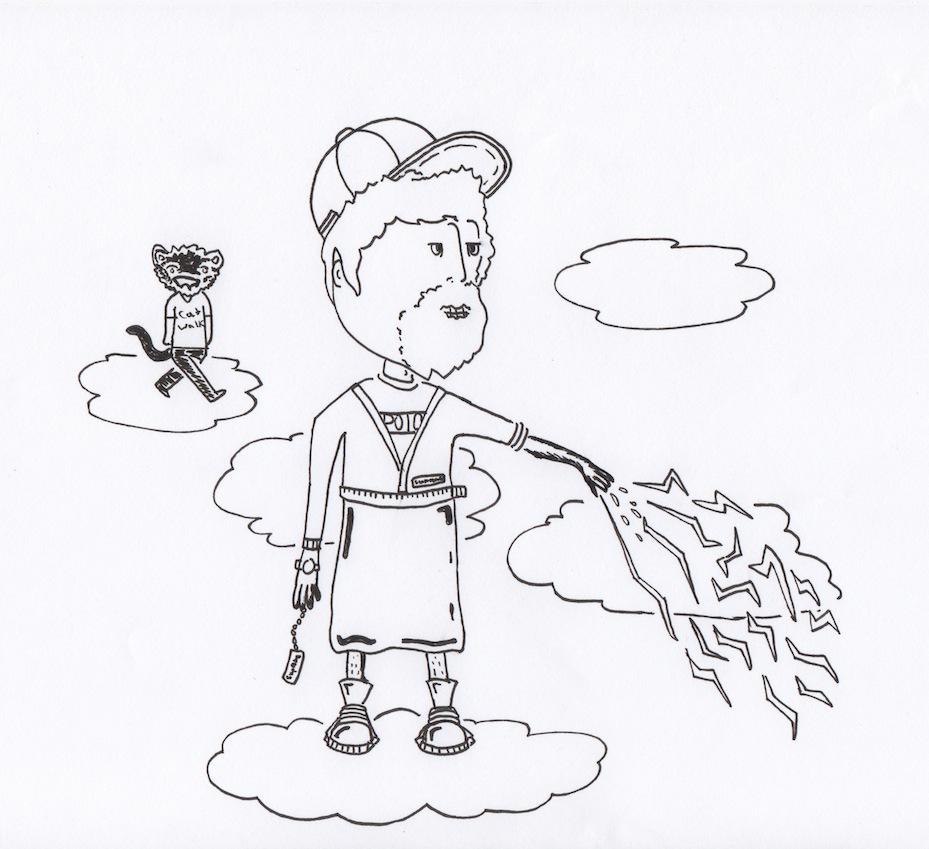
                                                                           Illustration by Clayton Mednick

As you know, I am not a person who goes looking for the hand of god in everyday events. I believe everyday events, by there very nature, are beyond god’s management. I don’t ascribe meaning to random incidents, accidents or unusual combinations of numbers.

Much is made of so called miraculous recoveries from medical maladies but as a matter of statistics they fall well within the curve of possible outcomes. In fact, most of the “miraculous” part is added by people and media looking for the hand of god in otherwise ordinary outcomes. It just goes to show, if your always looking for something to confirm your belief system, then your going to find it.

For instance, people talk about the miracle of childbirth. And you know, if it weren’t for the eight billion people crawling over every square inch of the globe I might be inclined to agree. But really, with over 380 thousand kids born every day and the very function of life being continuity, there doesn’t seem anything remotely miraculous about it. If anything it seems commonplace, even inevitable. Practically mechanical.

Survived a plane crash? So did most of the other people who have ever been in plane crashes. It is rare to the point of miraculous when everyone on a plane is killed.

The Virgin Mary’s profile on a potato chip? You want it? You got it!

9-11? Everywhere you look. Same as it ever was. You’re just looking for it now.

It’s called Confirmation Bias. People tend to seek out, focus on, and remember information that supports their ideas and beliefs while ignoring or downplaying information that contradicts or undermines their beliefs.

Why is it that people thank god for the recovery of a desperately ill child but they don’t blame god for trying to kill the kid in the first place? Confirmation Bias.

It’s why professional athletes thank god for the big win but they don’t blame god for the crushing defeat. Also because cursing god negatively impacts the bottom line of product endorsements. Simultaneous Confirmation Bias about both god and money. Not exactly a shocking revelation.

However, even I have to admit that once in a while my thoughts turn to god when there is a sign with clearly inescapable religious significance. The sign in question was seen by my own self in the sermon case outside of St. James Episcopal Church, 865 Madison Avenue at 71st Street, founded 1810. It read:

Does God Really Give Fashion Advice?

A sign from god? I like to keep an open mind so here we are giving it a little consideration.

It seems to me that before you ask the question of whether or not god gives fashion advice you would want to consider if you would even trust that advice. Sure it’s god but still, you have to be a little skeptical, right?

God and fashion?

(1) Is it Possible? I suppose anything is possible.

(2) Probable? Well, on first blush it doesn’t seem like a great fit.

(3) A good thing? Hard to imagine really.

The question of god being a good source of fashion advice is, admittedly, not the kind of thing one considers very often. I haven’t read the bible but I’m a big fan of religious radio shows. It is no small point of pride with me that I was listening to Harold Camping of Family Radio predicting the end of the world years before the end of the world didn’t happen. It seems to me that Family Radio’s byline “Feeding the Sheep” should have been the mother of all neon signs warning that anything coming across their airwaves was tongue in cheek, hand in wallet bullshit but did I mention Confirmation Bias?

My sister used to have a housekeeper named Ella Mae. Ella Mae summed it up this way; “I don’t know why everybody make such a big deal about the end of the world. Every day it’s the end of the world for somebody.” True Dat!

In all my years of listening to Brother Camping’s gravely voice peel the proverbial onion of scripture I never once heard him comment on the benefits of, or god’s preference for, florals versus checks, pleats or no pleats, wide lapels or narrow. One assumes that god prefers a necktie over an ascot but that’s just an assumption. Collar or no collar? Two button, three button or four button dress suit?  In fact, although I know it to be a mortal sin to wear White Bucks before Easter, I don’t believe that rule dates from the Roman Empire.

Tunic and cloak? There’s just nothing eternal about those threads.

Ok so let’s get back to the source of this conundrum. I’m not familiar with the Episcopalians so I had to look them up. It turns out they are the Americanized Anglicans. When the American colonies seceded from England it was necessary for the churches here to secede from the Anglican church because the Anglicans swore an oath of loyalty to the crown. So if the Episcopalians are basically an English order you have to figure any fashion advice would have to touch on the basics of English taste; namely Paisleys and Cross Dressing. Of course that also casts doubt on the Necktie versus Ascot assumption. Religion is so vexing isn’t it?

But doesn’t this all skirt the issue of expectation? What is it that we want from a god anyway? Is fashion really a good use of the almighty’s time? Isn’t god busy with something else? Anything else? Everything else? As it turns out, not really.

The physical universe is governed by physical laws. These laws are unbending both backwards and forwards in time. Using even our imperfect knowledge of these laws we are able to make accurate predictions about future events as well as accurate predictions about what the past will hold as we unravel every story of creation. It is these immutable laws that make accurate predictions on the macroscopic and microscopic level possible.

So, within the principals of uncertainty, the universe is a predictable system that runs itself. God doesn’t really need to bother with it. In fact, god can’t bother with it. The universe is itself beyond tampering with. That’s why we don’t see phenomena that don’t conform to physical laws. In other words, if it can’t happen, it won’t happen. Weather, while notoriously difficult to predict, does not happen in a way that is beyond explanation. It doesn’t rain cats and dogs. It doesn’t rain money. It may rain on your parade but it doesn’t rain rare scotch or cheap wine. It only rains water. That’s all. The fact is, many of life’s mysteries are not actually all that mysterious. You can see that the realm of god is actually a pretty narrow set of possibilities.

So what does god do with all that free time? When we complain of something taking an eternity, it’s only a metaphor. For god, it really is time without end. God must have been bored senseless.

Then along comes fashion. It is unfathomable. Truly unexplainable. And in that regard it seems like fashion may be an appropriate place, perhaps even the best place, for god to exercise the old creativity. Certainly it offers us a plausible explanation for Kilts and Burqas. On the other hand, while I suppose there’s something alluring about a nuns habit, these are not examples that inspire faith, for lack of a better word, in god’s capacity as a go to source for fashion advice.

Still, god can only work within the limits of his public and the tolerance of shareholders. The market is fickle and even god cannot afford to alienate followers or tamper with the brand image. You know, I’m starting to see the lines converging here. Maybe god really is an arbiter of fashion. But fashion in a really broad sense. Timeless, classic, refined, transcendent. That’s it! Transcendence! Of course! Art is a reflection of its creator and if the creator is, THE  CREATOR, what else would you expect? Religious crackpots (that seems like a redundancy) are always shouting “god is great” but maybe the reality is more subtle and nuanced. Maybe god is not simply great, but more importantly, god is graceful, majestic and elegant. Maybe god is, dare I say it? Fabulous!

So I think we’ve got a pretty good handle on the question now. It seems like god probably does give fashion advice. God’s tastes run to the restrained side. For the most part god eschews flash except for production numbers involving Pharaoh, at which point god is not above a little flamboyant ostentation though always steering clear of garishness. A certain austerity pervades god’s best work. God prefers an earth tones palette and traditional materials; flax and wools; silks for special occasions. Mantles and headdresses are common accessories and light footwear is a must. And jewelry. God simply loves a little sparkle. But tasteful; always tasteful.

God’s advice, like so many before, well not actually before, but like so many since, is likely to be about the fundamentals, while emphasizing brand authority.

 “I am thine God.”

“All powerful and not entirely displeasing to the eye. Yea even fetching in the right light. Thou shalt know that thine god’s couture is original and copyright; sovereign and inviolate.”

“No knockoffs or else. Do not tempt my wrath.”

“Thine god loves you and blesses you with this fashion tip which truth is eternal.”

“It is not what thou weareth. It is how thou weareth it.”


“Now I, your god, command you to go forth and be your ravishing self.”