I Hear Voices

I have this friend. We’ll call her Melissa Stern because that is her name.

Melissa Stern is a sculptor and a brave, or perhaps foolhardy, one because she has allowed others to tamper with her work. I am one of those people so perhaps temerarious would have been a better word but I don’t know how to use it in a sentence.

One of the reasons people become artists is that it gives them ultimate control of the universe; even if it is only the universe of their work. It is a godlike responsibility because, as Uncle Ben would tell the youthful Peter Parker shortly before being offed by a criminal; “With great power comes great responsibility.” As we all know, Peter’s initial indifference to crime, even as Spiderman, caused him to decline the chance to stop a fleeing thief. His apathy caught up with him later the same day when the same criminal killed his Uncle Ben during a burglary. Oh,The Irony!

Melissa Stern, in her role as god, has created woman and man. Seems stereotypical doesn’t it. A requisite skill; indispensable for any deity’s curriculum vitae.

~~~~~~

“Ok, have a seat. Let’s take a look at your resumé. Stars in the sky; Good. Animals of the land; very nice. The giraffes are an especially nice touch. Fish of the sea; check, Plants; good, a lot of hidden drama there. Very nice. You do nice work. So, let’s see your people.”


“Hmm?”


“What do you mean you don’t do people?”


     “What are we talking about here!? It’s not ethical!? It messes up a perfect system!? What!? What’s the issue!?”


“I see. They’re not part of your idiom.”


“Ok, ok, well look, it’s been a pleasure. If anything comes up we’ll give you a call.”


~~~~~~

Melissa Stern’s people have the disconcerting quality of looking on the outside, the way people are on the inside. Conflicted, misunderstood, innocent. 

Stern has put together a collaborative, interactive exhibit. She asked some writers to choose a sculpture and write a monologue from the sculpture’s perspective. Reckless on her part; like inviting another deity into your universe on a per diem basis but admirable nevertheless. An act of faith. I am fortunate because I am her friend and because she allowed me to choose the piece about the death of her father, Bernie.

The monologues were recorded and each sculpture has been tagged with a QR Code so a smart phone can play the reading while you look at the work. Viewers can also add their own comments that are then available for playback.

I wrote the monologue from the perspective of the Willy Loman character schlepping across the girls head.

*

She was Juliet. I was not Romeo.


More like Odin the wanderer.


I was no hero but to her. 


At dawn, I would perform my morning ritual and then … disappear. She thought it was magic. I thought it was my job. I didn’t know what else to do. Then, at dusk, I would reappear to rescue her from the night.


Magic!


She was beautiful. Not like scary beautiful. More like beautiful girl who liked me, beautiful. I couldn’t stop looking at her. She was an innocent. And for a time, we had each other. “Forever!” she would say.


We had hopes. Like everybody else. Special and mundane. I hoped she would be happy; she hoped for the moon. We lived in tenements and apartments all over this town. We cooked and did laundry; and went to see movies and theater and music. Moving. Restless. Together under all those different roofs.


The magic was between us. She thought that would be enough. I knew it wasn’t. I was the grown-up. I could never bring myself to tell her. I didn’t want to break her heart. I knew it would break, in its own time, of its own fragility. And when it broke, I knew that I would be one of the pieces; brittle and sharp.


A fragment is made new by its incompleteness. A shard is not an urn. It is a new memento of something old. Once broken it can never be called broken again. I preferred it that way.


Of course I had to leave. It was the only way. The only way I knew. So many years getting up. So many years washing my face; like an act of purification. Dressing, collecting my .. self, walking out the door. Out. Ever out.


I had to leave. It was the only way I knew.


*

For the reading by Michael Samuel Kaplan follow the link below

 http://melissa-stern.com/gallery/imagegallery.php?subdir=The_Talking_Cure&numb=2

Tick Tock Diner

Time, so they say, is irreversible. The Past, so they say, is different from the future.

Time does not stand still.

I went to college for seven years. Even so, I am at least a couple of years away from a Bachelor’s Degree. My freshman year was three of the best years of my life. The same could be said of my sophomore year. So much for the vaunted rules of time.

One of those sophomore years was spent at the University of New Hampshire. I lived in a house with 15 other people. We each had our own room of a divided up old Victorian. We shared three bathrooms and two kitchens; one on the ground floor and one on the third floor.

The ground floor kitchen had several refrigerators. We each had a section of refrigerator but my friend Dave likes to tell it that when I was hungry I would, in his words, forage through them all. Forage is his word now. I can’t think it or say it without making a mental note of him.

For the record and in the interest of fairness my friend Dave disputes many, if not most, of the facts in this story. However, since I am the writer, I would like it known that Dave is a notoriously unreliable, not to mention uncooperative, witness. Furthermore, during this time, Dave was a degenerate drunk, an unrepentant sybarite and a known communist sympathizer. And it is This Reporter’s Opinion that he also practiced….. WITCH-CRAFT!

That said, I don’t recall if I treated all those refrigerators as my savannah but it’s entirely possible. I still eat that way when left to my own devices. I’m less of a hunter-gatherer and more of a scavenger. An opportunistic eater one might say.

Apparently I was able to avoid drawing predators, in the form of angry housemates, by employing a survival mechanism that I like to call Nibble and Move. Pretty self explanatory and altogether successful when coupled with the track covering behavior of fluffing the refrigerated leftovers to camouflage my covert snacking.

The upper kitchen was outside of my natural habitat but not outside of my interest. I used that kitchen to boil road kill that my Anthropology Professor had buried for a season. You know, to get the last furry bits off. He was making a skeleton collection of local fauna. I don’t know what I was thinking but I’m afraid I thought it was a good idea. His name was Howard Hecker.

When Howard and I first met he said ”Mednick eh. Are you related to the poet Mednick?” I answered that I thought it was possible but probably not. Then he asked if I knew Hecker flour and of course I did. Even back then, barely nineteen, I occasionally baked bread. “Yeah” he would say, “I’m not related to them either.”

One of the fellows who lived in the house was named Robert Armstrong. “All American Boy”, my mother would always say when hearing his name. Surprisingly, his was not the most memorable name. That belonged to the birdlike and serious Cat Sleep. A definite top floor turret dweller, she lived in the round room. She was serious, industrious and motivated. A genuinely diligent student, she would make any professor proud. We shared nothing in common.

Over Christmas break, Robert Armstrong, “All American Boy”, had moved out and now lived at another house out in the boonies between Dover, where I lived and Durham, the town where the University was and I presume still is. That house was called Shaky Acres and every full moon was occasioned by a Full Moon Boogie, after the song of the same name by Jeff Beck. I can no longer remember how many of those Full Moon Boogies I attended but whatever the number I can only recall one. And of that one I remember nothing. I don’t think it was because I’d had too much to drink, although chances are pretty good that I was drunk, but only that so much time has passed.

Everyone thinks about time. The great distance between then and now. Where does it go? Whatever happened to my dearest what’s her name that I loved so well? How did I become here? How did I get here is a question of time as much as circumstance but adds the fleshy dimension of history and the question of free will.

History is the accumulation of events. Events exert pressure on subsequent events.

Pressure subverts free will.

My friend Mike is a city planner or would be if he weren’t working for the MTA. There was no work in city planning and after years of trying he settled for the MTA and a steady meal ticket. Mike’s family came from Ireland in the 1840’s, driven by the potato famine. After passing through New York harbor they joined the push west to Ohio and opportunity. And then on to Illinois. Failed farmers they joined the California gold rush. And then north. And then back east to Chicago. Finally settling down in New York, the very place they had departed more than one hundred years earlier. A trip of generations in search of a bite to eat.

Were they really making choices or were they pushed along by the force of history? Is it free will to follow a trail of survival? Are any of us exercising anything more meaningful than the choice between low fat and skim, caf and decaf? It’s the past. The past propels us forward. Again and again we steer blind but experienced, into the headwinds of the oncoming present, looking for calm and a cessation of hunger.

A Thought for Your Penny

Memory is a funny thing and for pretty much all the reasons that everyone says. It’s selective and subjective, cherished and requisite for a good liar.

My father, a photographer, once or probably twice since he never thinks I listen the first time, told me that we remember colors in reverse. The color we remember an object being, is likely to have been its compliment. Which is to say we remember colors by their contrast. An interesting idea since it suggests that memory is as much about remembering what a thing is not, as much as by what it is.

I remember three of my father’s photo studios. The earliest was over an appliance store called Nate Ben’s Reliable. I was very young, no more than three or four years old, and as I recall the place had no ceiling. Every surface had been painted black for better light control. The walls seemed to rise on up and disappeared into the night sky; into outer space but without the stars. In that studio it was always nighttime. It was always a moment before the big bang. All potential.

A visit to my father’s studio meant play time in the prop racks; trying on clothes and looking for treasures. There was one prop, a giant horse-shoe magnet, that was too large for the prop area. The magnet, in reality just plywood and paint, was left over from a Smith-Kline Pharmaceuticals shot for a children’s iron supplement. This was back when vitamins were pitched to parents instead of directly to kids via cartoon character shaped pills. The giant magnet was always around but never in the same place twice. Slowly orbiting the studio it was, I imagine, a force of creation; emitting invisible fields of attraction and repulsion.

The studio was a place where time moved in uneven intervals. Eons would pass; nothing would happen. And then, without warning, all the lights would go out. You were suddenly alone, afloat in the blackness. The strobe lights would flash, POP, and you’d be blind for a moment from the whiteness of it all and that meant a new universe had been recorded on film.

After everyone’s vision cleared, my father would jockey people and props around; darkness and then, POP, another new universe would appear on film. He always said that being a photographer was a lot like being a salmon. You shoot frame after frame, roll after roll like a salmon laying it’s thousand eggs in the hope that one survives the jaws of the art director.

Things were always getting lost in my father’s studio. Lenses, props, bills, wardrobe items; nothing got lost as much as the prints themselves but nothing got lost forever. Eventually a finished print would show up, sometimes weeks later, and the key thing was that you had to grab it when you saw it. Even if you didn’t need it at that very moment. A mental note of its last known location was not enough. These sightings were random and fleeting. Like some rare and endangered sea mammal it would surface for a breath and then disappear. You captured it right then and right there or it would be gone again and for how long nobody could say, submerged as it was in the chaos and clutter of a busy studio and a creative mind.

My job in heavy construction shares some of those qualities. There is always a lot of old stuff where I work. When you are doing excavations and building foundations you necessarily have to dig up the past. Old building foundations, old piers and sea walls; a reminder of the shifting contours of this island and the evolution of land usage. In an old city like New York the past is always getting in the way of the future and while sometimes it can be worked around or even incorporated into new designs, more often than not it has to be removed and sent to the dump.

Not so long ago I was working in a hole in the ground burning a pipe pile. The pile, full of reinforced concrete, was for a new building foundation. It was a 48 inch wide pile with 3/4 inch thick steel walls. We were burning the last dozen feet off to bring it to proper grade for the pile cap; the part that ties the piles to the building itself. 48 inches might not sound like much but that’s the diameter. The circumference is near 13 feet so we work in pairs. My buddy Matt was burning from one side and I was burning from the other. Whenever I’m asked if I can burn I always say I’m adequate. In reality I am very competitive and proud of my burning. I’m not always the best but I’m always in the running.

Burning, like a lot of things, is actually several events encompassing a wide range of skills. You don’t always cut flat plate and you don’t always cut flat. You cut rust, which is not only time consuming but painful because rust doesn’t melt. The good steel melts and the rust causes the red-hot slag to spray back at you. In burning, as in working out of doors, it helps to know how to dress and also to have a fairly high tolerance for pain. But it’s okay. It reminds you that you’re alive.

There is also burning an object at or under the water line, which is either fun or incredibly irritating depending on tidal issues. And then there is burning a non-hollow object. In this case a steel pile full of reinforced concrete, as I’ve said. I’m pretty good at this type of cutting and was well ahead of Matt when I looked up to change positions. If you’re not comfortable, you aren’t going to burn well so you should be changing hand or body position almost constantly.

There was a pool of muddy water to my right and a wet embankment in my face. To my left was the pile. I had put a piece of lumber in the water and was leaning into the pile while balancing my toe on the slightly submerged scrap timber. When I looked up there was a disk on a little outcrop in the embankment. I picked it up and figured it was a washer but then there was no hole in the center so I slipped it into my pocket. As I was standing with the pipe drillers a short time later I took it out to have a closer look. It turns out to be a coin of some sort. I scratch it clean with my wet fingernail and it looks like it says…. let’s see.. ONE …uh..C*NT. ONE C*NT. Well how do you like that? It must be an old token from a Times Square peep show. Even so, that seems a little harsh.

Then I turn it over and there is a lady’s head with a banner on her brow, which reads LIBERTY. Wait a minute! That’s not ONE C*NT, it’s ONE CENT. ONE CENT and this thing is old! It’s scraped on one side where the back hoe bucket must have caught it but only three of the original thirteen stars are missing and it says 1883 or is that 33? My eyes are too gone to tell. But yes I’m sure it’s 1833. One of the crane operators says his brother collects coins and proceeds to call his brother who takes the info and says he’ll call back. He calls right back and tells us that it’s worth between 5 and 25 dollars depending on condition.

At home I get out a photographers magnifying loop, a souvenir of my father’s studio, and sure enough it’s 1833. When I showed Matt the next day, he said “Hey look! That head is the Statue of Liberty” which of course would not exist for another 50 years. I, of course, told him. It’s rare that I can correct Matt without his wanting to kill me but I know it’s all affection so I don’t normally worry too much. I just suffer the arm punches with as much good humor as I can muster and a very modest amount of internal bleeding. A couple of days later I showed the coin to my German friends. In 1833, Germany as a state would not exist for almost another forty years. My German friends didn’t think that was particularly amusing.

And here it lay, not only at the tip of Manhattan but in the landfill behind the crib wall that formed the southern seawall in the 19th century. Not only that but I found it in this triangular pit about 60 feet on a side. It is the confluence of the old 1/9 subway line turn-around, the FDR to West Side Highway tunnel and the N and R trains. And water mains. And gas lines. And air shafts. How had it not been found before? This tiny parcel of land has been turned over like a fertile field dozens if not hundreds of times. This is made land. Nothing of it exists except by the hand of men. And I do mean men. As the guys like to say “If it was easy they’d have the ladies doing it.” Sexist yes but fundamentally true. There are no girls out here although I have heard of some with the termites; the carpenters. The lone female is the sister of my foreman and on the job friend, Alex. Alex and I would never meet socially; he’s devout catholic with all that implies, and I am lost cause. Third generation Dockbuilders; she’s the exception that proves the rule. Or disproves it. Your call.

But anyway, you get the idea, it was old and here. Right here in the dirt. And always had been. Or had it? Was it picked up from somewhere else? Part of a ground up building or excavated soil recycled into landfill? The past becomes the present becomes the past. You know there is a market for landfill just as there is a market for land. What do you think landfill is? It’s land!

And how did it get here? At the end of a concrete pour you will often see a laborer toss some money into the wet mass. An offering to god. Thanks for not letting the form blow out. Was that it? Or did it fall out through a hole in someone’s pocket; the better part of an hourly wage, all that time ago. Who’s hand did it touch last? How did it get here?

How? I’ll tell you how. It was dumped by circumstance.

So, is that the meaning of it all? Is that all that it means? This penny?! This penny had evaded capture for over one hundred and seventy years to get to my hand. It is why I prefer used books. It seems like you don’t find them, they find you or better yet you find each other. Forces of attraction guiding small changes in direction toward an ultimate goal. Like all the history of the world has led up to this meeting. This utterly meaningless meeting.

This singular moment, this pointless event, will probably not echo in eternity but it does remind me that the ball is rolling. That weak forces as well as strong ones are at work and that seemingly unrelated events tie it all together. And the penny? I don’t know where it is right at this moment but sooner or later it will surface, like a lost photo in my father’s studio.

Sexy Shorts

It has been suggested to me that my oeuvre does not contain enough sex. I thought oeuvre was French for egg. I became concerned because I didn’t know how to fold that into an erotic situation. I suddenly became worried that everybody knew something about sex that had just completely got below my radar. Then I learned that oeuvre is French for work and it started to make a little more sense.

Prurient thoughts are not foreign to me. Or anyone else for that matter. Be that as it may, I wish the suggestion for sexier content had not come from my 77 year old mother. It’s a little awkward. Everyones parents are sexual creatures but who wants to dwell on that? Still, a person always wants to please their mom.

~~~~~o~~~~~

My maternal grandparents were married for more than fifty years. They met on the telephone. My grandfather was a telephone switchboard operator at City Hall in Philadelphia. This was way back when there were switchboards and operators. My grandmother was calling City Hall on some forgotten mission. This was way back when you could call City Hall. She liked the sound of his voice. They met, had premarital sex and married shortly before the birth of my uncle Gibby.

My grandmother once announced, half complaining, half teasing and entirely without discretion, that my grandfather couldn’t really do “it” anymore. She could be tactless. After his third or fourth heart attack I guess he just couldn’t manage the necessary blood pressure but he was an even tempered man, if you discount the life long gambling binges. His response was “I’ve been fucking for more than 50 years. You’ll see. When you get to be my age, it’s not that big a deal.”

~~~~~o~~~~~

Thirty years after the birth of my uncle, my father caught site of my mother wearing white short shorts, no bra and a tight t-shirt. They were married, after an unusually affectionate courtship, not long before my sister was born. Not long at all.

I can remember waking to the sounds of them talking and laughing. My room was down the hall from theirs. I couldn’t make out the conversation, muffled as it was by doors and blankets on both ends but laughter is laughter. It had all the sounds of happiness and intimacy. Needless to say the divorce, though many years later, came as a surprise but their laughter is still at my core. They lost it for a time but I will always carry it. I have long considered it my most important memory.

~~~~~o~~~~~

My wife is a beautiful, mixed-race black woman. As the kids like to say, “Dad, you’re the only white person in our family.” We kissed at a Halloween party when she was twelve. I had just turned fourteen. It didn’t go anywhere. Where was it going to go at that age? We met again when she was nineteen. It was immediate and overpowering but we were young. We struggled with commitment until marriage and have never turned back since that day. She has a lovely caboose that has grown a bit over the last few years. As love would have it my tastes have changed along with her contours.

We are in our middle years and one day is very much like the next.

It’s the end of the day. The boys are warm and quiet in their beds. A load of laundry is tumbling in the tropical heat of the dryer. Plates and cups are being soaked in the scalding waters of the dishwasher. I shower and get under the covers to read and warm the bed for her, propped up a little by soft pillows. She bathes long. A displaced marine mammal from somewhere near the equator, she is in repose, submerged in the placid, steaming lagoon of our bathtub; grateful for a reprieve from the thin air. She comes to bed, her skin still warm and damp. She lays on her side, her head resting on my chest, one leg entwined with mine. We sleep together and we depart for sleep together. The lights are out and our breathing falls into harmony. I rest my hand on her hip. We exchange a few words of love talk and my hand slips down and around to her lower back. I stroke her soft backside. It’s very quiet. Then the whisper, “I want to snuggle.” It’s not our code. It’s not a secret invitation. It’s our little guy. We didn’t hear his soft approach. He’s ready for love.

What the Dickens is going on here?

Hey Drew,

Is it me or has this gotten to be a really long century already? Barely a dozen years into it and I’m exhausted. Dispirited even. As a more modern Dickens might have said: “The season of light, this ain’t.”

The wars, the environmental catastrophes, the wild stallions of unbridled greed. The self righteous barf coming out of every self serving jackass for whatever the moronic cause of the moment happens to be. TV talking heads pushing divisiveness like it’s ice cream. The reactionaries. The holier than thou hypocrites. The willful ignorance. The lambs and their slaughter. The liars and their willing minions. China and Russia. Again! The Mideast which, by the way, I’ve been sick of at least since Raiders of the Lost Arc.

And then there’s genocide. I mean, you would think we’d of had about enough of genocide but it remains as popular as ever. It’s kind of the default bottom rung along with sexual slavery and kidnapping for body parts. You’ll be gratified to know that there is an official list of world problems (suitable for framing) and that those little gems all made the cut.

The list of the Top Ten Problems of Humanity for the Next 50 Years reads like a David Letterman top ten monologue of the apocalypse. The list is as follows:

Energy

Water

Food

Environment

Poverty

Terrorism & War

Disease

Education

Democracy

Population

Genocide

Other Atrocities (e.g., trade in women and children for sexual slavery, or kidnapping for body parts)

Weapon of mass destruction (nuclear proliferation, chemical weapon proliferation, biological weapon proliferation

Transnational organized crime

The single word entries are by qualified scientists unassociated with any partisan think-tanks or groups with a name that ends with the word “Institute.” The intensely verbose entries are by “The High Level Threat Panel of the United Nations.” Typical of decision making by consensus. Everybody in a group effort wants to get credit. Whatever is gained by overall consent (if not exactly agreement) and the resolution of objections, is bought at the expense of brevity.

Admittedly this list is more than ten and, ok, it’s a combination of a few “Lists of 10” but that just goes to show you how discombobulated we are as a species. No doubt, there are plenty of animals that foul their own nest but I’m pretty sure we’re the only ones that have a real good look at the pile and then sit back down on it.

And its not like I’m a big news hound. I’m informed to the point of worry but ignorant enough to avoid being paralyzed with fear. I like to think of it as a balanced approach that favors sanity. And, in any event, I don’t believe my hand wringing changes anything about the forces in play. Still, I resent the partial reporting of news and how it has become a way of leveraging offscreen private interests. It’s little wonder that people like their tranquilizers. I want to be tranquil too but I think drooling is unattractive.

Did you know that Americans eat about 25 million Percocets and Vicodins a day? Over 244 million narcotic prescriptions a year? Holy cow! No wonder we can’t get off the couch. It’s a testament to our boundless stamina that we can even operate the remote. But that doesn’t explain or excuse Ranch Dressing flavored Doritos. Caffeinated candy bars, Torture, Tilapia, Fried Twinkies, Corporate Hegemony or Low Carbohydrate Beer.

Thankfully there is an explanation. My dad is presently a day older than god. But back when he was in his sixties and between marriages he had a girlfriend. She was a prominent doctor at an important teaching hospital in Philadelphia. She was super smart, attractive, caring, worldly, affectionate and willing. Unfortunately she also reminded him of his own mother so the relationship was doomed. Nevertheless, she had a wealth of clinical experience and she understood all these trends. Her insight was as follows: “95% of everyone is an asshole.” Assuming for the moment that I am in the 5%, who am I to argue?

I don’t watch television and I haven’t in many years but it is almost all anyone talks about anymore. Maybe that’s not true where you work but it certainly applies to the pudding-heads I’m mixed up with. Don’t get me wrong, they’re a great bunch of guys but they think that TV is real. They think watching television is an activity. Like playing tennis or reading or going for a walk. And I suppose it is an activity if you take out the active part. From their conversations, it sounds to me like going to your job and having some network air the results is now cause for celebrity. Hell, you don’t even have to go to work. I’ve heard them talking about celebrity video gamers, celebrity card players, celebrity eaters, celebrity adulterers, celebrity driving, shopping, dieting and dancing. Those last two, you can have separate or in combination. Aren’t those things we already do ourselves? You know, except for the adultery. That’s always someone else. Just ask the moralists.

For many people, life has become a spectator event. Safe at home, life has been outsourced to onscreen professionals. But to hear tell it, they don’t do any better of a job than we do. Often times not even that good; and that’s saying something.

Add it all up and it just seems like this is the worst of times.

And you know what? We already know what’s going to happen for the rest of the century. Do we really have to slog through the particulars? Way hotter, lots of extinctions, rising sea levels, mass displacements, environmental degradation, overpopulation, famine and wars. Lots of wars. Wars for resources, civil wars, culture wars, holy wars. Pretty much wars for war’s sake.

I guess you can see where I’m heading with this.

I say no!

Let’s not bother. I’m ready to move on to the 22nd century right now. Who’s with me?

History only looks linear because we’re standing at the end of the line. I say let’s break the line. Let’s put an end to the tyranny of chronology. The narrative is ours to arrange, or rearrange, as the case may be. Historians and pundits do it all the time. Let’s take the present and just push it into the past. Let’s allow the glorious past to become the future. And let’s take hold of that shining future and make it our magnificent splendiferous present.

Genius right?

Ok, so let’s take a look at some long term predictions about the 22nd century and see what “far, far better things” we have to look forward to.

……Oh my! That’s not good.

You know, I was talking on the phone with my mom today. She has a new hip and its working out great. And as I sit here on my sofa, writing on my iPad, drinking fair trade coffee with the smell of bread baking in the oven, the kids evolving around me and my wife tossing me a wink, I suddenly realize what they mean by the duality of life. Yes, spring came a month early this year. It is worrisome! But the flowers are lovely.

I guess when Dickens said “It was the best of times, it was the worst of times,” he had a good reason for putting it at the beginning of the story. It’s the beginning of every story! It is the human condition. Every moment in history can be characterized that way. There are surprises in store but there are no endings. And as the cheat sheets remind us:

There is a constant tendency toward violence and oppression.

There is always the necessity of sacrifice.

There is the ever-present possibility of renewal and redemption.

Palm Reading

Palm Beach is not a place that invites comparison. It is not a place that makes you think of other places.

It might be a place that other places makes you think of, but no place comes to mind.

The basic components are the same as any beach; sun, surf and sand, but here, even those few elements mess with your expectations.

The sun is sharp, the way it is at high altitudes where the air is thin. But of course the air here is heavy with water and the essence of plants. Like a character in a movie it seems to be more itself than it is in reality.

The sand is not so much pulverized stone as it is finely crushed coral and shell; ground down so fine that it fools your toes. It takes me four days to realize this and only after having built multiple sand castles with my three little guys and digging countless holes looking for sand crabs for them. I don’t find any but on the fourth day a fellow walks by with a five gallon bucket half full of them. Like in their hurry to avoid me they all jumped into his pail. It feels a little personal.

I have also been digging up dozens of Burrowing Crab holes that have not once yielded a crab. On our last day, I run into Mr. Sand Crab again. It is he who actually tells me the holes I’ve been digging up are Burrowing Crabs and he says he sees them all the time. He’s starting to get on my nerves. I’m also beginning to think this beach is deliberately toying with me.

And then there’s the water. I give up on the water. Twenty years working on the water; high water, low water, slack water, up and down twice a day but this tide is a mystery to me. Each day the ocean seems to choose a tide it likes and it stays at that level all day. I’ve never seen anything like it.

We are three families on vacation with five children among us; guests of old and dear friends. The kind of friends that cannot be made after a certain age. I don’t know if it’s the shared battles of youth or the constraints of adulthood but the depth of feeling, of trust, is not possible after a certain age. Once you know who you are it isn’t possible to know other people in the same way.

On our last morning, looking out on the Atlantic, there was a low water calm and no breeze to speak of. I went about gathering mask and snorkel and boogie board and set out upon the quiet sea to discover… whatever.

As I wade into the surf my feet press down on the mortal remains of countless sea animals deposited over tens of millions of years. I walk out about ten yards, lie on the boogie board face down and paddle. The bottom gives way to nothing but rippling sand for a long while.

The optical properties of mask and water make it appear that I am in just a few feet of water but putting feet down to test for depth I am unable to find the bottom. I let go of the boogie board and plunge headlong into this other atmosphere. The bottom is a foot or a yard or a mile away. However near or far, it is beyond my reach. I return to the boogie board and resume my effort. I paddle for what seems like quite a while but time, like distance, is difficult to gauge on the water where no reference points exist.

All of a sudden I see a silver fish and then many and within a few minutes I am floating over thousands of them. Big and small but all appearing to be the same. Herring I’m told; slowly swimming and as calm as the rippling sand. I look down on them the way aliens must look down on us, with detached amusement.

My mask, pink and perfectly fitted to a ten year old girl, is slowly taking on water. I lift my head to clear the water and have a look around. Calm sea. No indication of what lies beneath the surface, beneath my dangling feet. Hidden yet totally exposed. Head down and there they are completely out in the open. Head up, gone. Down, up, down, up. These two worlds spanned by my body and by my attention. My head in the clouds the earth far below my feet and me suspended like a hopelessly undereducated astronaut.

Tomorrow I will be back in New York at work and I will open the paper and find a picture of a twelve year old boy smiling next to the carcass of a 551 pound Bull Shark caught at Palm Beach. It will be declared a state record besting the previous carcass by more than 30 pounds. But that is tomorrow.

Today I am far out in the water off the beach. It seems probable that one of the boats that I can see from my low position in the water is the one carrying the boy to his inevitable destiny. He doesn’t know that he is heading toward the shark. The shark doesn’t know that he is heading toward the boy. And I certainly don’t know that I am likely swimming between them.

Each of us has a date with death. This boy will be the agent, the proud agent of this sharks demise. It makes me think how odd it is that we picture the grim reaper as a tall, cloaked and hooded figure, quiet as the grave. It is not so. Each of us is the agent of death for each of the other. Sometimes it is in one great struggle. A struggle that may be going on even as I am afloat in the warm waters, face down, immersed as I am in this cradle, swimming with the fishes. But more often I think that we are each, incremental slayers of each other. It is no one great battle but a thousand skirmishes that does us in. As the father of three boys I say this with a lot of confidence; the devil isn’t in the details, he’s in the other room fighting with his brothers.

Returning to the house, the villa, involves a transition from the beach through green gardens that surround it. Gardens that include a private nature trail. A description of its lushness seems pointless. I’m not that articulate. Take my word for it, it’s lush. Really, really, lush. The owner, father of our hostess, is a self described “frustrated architect.” He is also an accomplished amateur landscape architect and collector of exotic plants. The house, private apartments arranged around a sliced coral courtyard and fountain is all white columns and tuscan terra cotta roof tiles. The rest is greenery.

It’s on the beach but nestled in among the palms and aloes and whatever else you call these shady cool bushy broad leafed things and in this it is unusual. You might say that its most prominent feature is that it’s concealed.

I’ve been up and down this beach and every house, great or grand, palatial or simply extravagant, is fully exposed. Some beyond great incongruous lawns, others right on the beach but all with a pornographic full frontal quality; “Hi. my name’s Lance. What’s yours?”

But this house, this restrained house wrapped in its protective gardens appeals to the blend in, assimilate, stay below the radar jew in me that has I’m sure, to some extent, made me uncomfortable with aggressively promoting myself. On the other hand I haven’t had my village burned recently so survival-wise it seems like the way to go.

That of course is not a problem that the owner of this place suffers from. Yet the place definitely says something about the man. He has carefully and shrewdly guided his legacy, the family business. He has made it into a giant, privately held corporation that you very likely never heard of.

In this house we are not so much guests as we are a group mingling around food and drink, pool and beach, reading, music, talk and quiet.

There is no timeline and no schedule. Nothing seems imminent. We are each moved as movement dictates. We are somewhat amoebic in our integrations and disintegrations.

We are all, in our middle age, bonded in our common sense of leisure. There is no other agenda and nobody has anything to prove. We are each ourselves within our capacity to be ourselves. We are all comfortable with quiet. The lack of entertainment affords unlimited opportunities to notice the minute details of pleasure; small scenes, textural contrasts, atmosphere.

The young are, as ever, immune to pleasure confusing it as they do with excitement. But I have no old man’s lament about youth being wasted on the young. For although I was young once, and wasted, now I see it as each according to his ability.

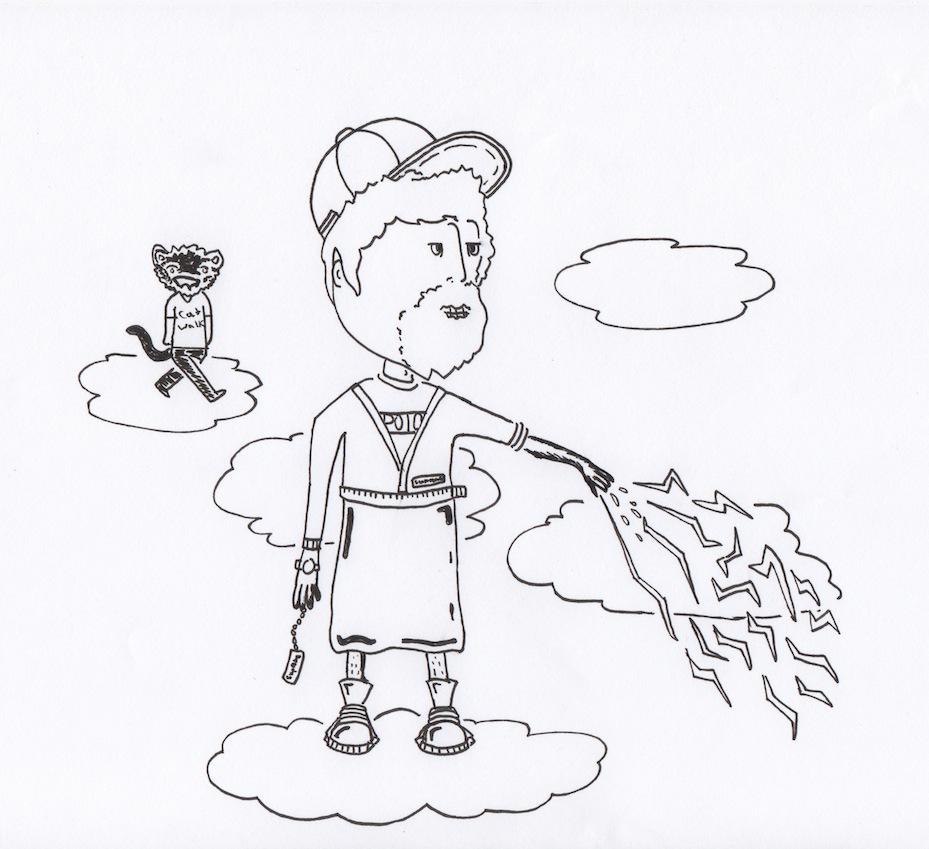
OMG

                                                                           Illustration by Clayton Mednick

As you know, I am not a person who goes looking for the hand of god in everyday events. I believe everyday events, by there very nature, are beyond god’s management. I don’t ascribe meaning to random incidents, accidents or unusual combinations of numbers.

Much is made of so called miraculous recoveries from medical maladies but as a matter of statistics they fall well within the curve of possible outcomes. In fact, most of the “miraculous” part is added by people and media looking for the hand of god in otherwise ordinary outcomes. It just goes to show, if your always looking for something to confirm your belief system, then your going to find it.

For instance, people talk about the miracle of childbirth. And you know, if it weren’t for the eight billion people crawling over every square inch of the globe I might be inclined to agree. But really, with over 380 thousand kids born every day and the very function of life being continuity, there doesn’t seem anything remotely miraculous about it. If anything it seems commonplace, even inevitable. Practically mechanical.

Survived a plane crash? So did most of the other people who have ever been in plane crashes. It is rare to the point of miraculous when everyone on a plane is killed.

The Virgin Mary’s profile on a potato chip? You want it? You got it!

9-11? Everywhere you look. Same as it ever was. You’re just looking for it now.

It’s called Confirmation Bias. People tend to seek out, focus on, and remember information that supports their ideas and beliefs while ignoring or downplaying information that contradicts or undermines their beliefs.

Why is it that people thank god for the recovery of a desperately ill child but they don’t blame god for trying to kill the kid in the first place? Confirmation Bias.

It’s why professional athletes thank god for the big win but they don’t blame god for the crushing defeat. Also because cursing god negatively impacts the bottom line of product endorsements. Simultaneous Confirmation Bias about both god and money. Not exactly a shocking revelation.

However, even I have to admit that once in a while my thoughts turn to god when there is a sign with clearly inescapable religious significance. The sign in question was seen by my own self in the sermon case outside of St. James Episcopal Church, 865 Madison Avenue at 71st Street, founded 1810. It read:

Does God Really Give Fashion Advice?

A sign from god? I like to keep an open mind so here we are giving it a little consideration.

It seems to me that before you ask the question of whether or not god gives fashion advice you would want to consider if you would even trust that advice. Sure it’s god but still, you have to be a little skeptical, right?

God and fashion?

(1) Is it Possible? I suppose anything is possible.

(2) Probable? Well, on first blush it doesn’t seem like a great fit.

(3) A good thing? Hard to imagine really.

The question of god being a good source of fashion advice is, admittedly, not the kind of thing one considers very often. I haven’t read the bible but I’m a big fan of religious radio shows. It is no small point of pride with me that I was listening to Harold Camping of Family Radio predicting the end of the world years before the end of the world didn’t happen. It seems to me that Family Radio’s byline “Feeding the Sheep” should have been the mother of all neon signs warning that anything coming across their airwaves was tongue in cheek, hand in wallet bullshit but did I mention Confirmation Bias?

My sister used to have a housekeeper named Ella Mae. Ella Mae summed it up this way; “I don’t know why everybody make such a big deal about the end of the world. Every day it’s the end of the world for somebody.” True Dat!

In all my years of listening to Brother Camping’s gravely voice peel the proverbial onion of scripture I never once heard him comment on the benefits of, or god’s preference for, florals versus checks, pleats or no pleats, wide lapels or narrow. One assumes that god prefers a necktie over an ascot but that’s just an assumption. Collar or no collar? Two button, three button or four button dress suit?  In fact, although I know it to be a mortal sin to wear White Bucks before Easter, I don’t believe that rule dates from the Roman Empire.

Tunic and cloak? There’s just nothing eternal about those threads.

Ok so let’s get back to the source of this conundrum. I’m not familiar with the Episcopalians so I had to look them up. It turns out they are the Americanized Anglicans. When the American colonies seceded from England it was necessary for the churches here to secede from the Anglican church because the Anglicans swore an oath of loyalty to the crown. So if the Episcopalians are basically an English order you have to figure any fashion advice would have to touch on the basics of English taste; namely Paisleys and Cross Dressing. Of course that also casts doubt on the Necktie versus Ascot assumption. Religion is so vexing isn’t it?

But doesn’t this all skirt the issue of expectation? What is it that we want from a god anyway? Is fashion really a good use of the almighty’s time? Isn’t god busy with something else? Anything else? Everything else? As it turns out, not really.

The physical universe is governed by physical laws. These laws are unbending both backwards and forwards in time. Using even our imperfect knowledge of these laws we are able to make accurate predictions about future events as well as accurate predictions about what the past will hold as we unravel every story of creation. It is these immutable laws that make accurate predictions on the macroscopic and microscopic level possible.

So, within the principals of uncertainty, the universe is a predictable system that runs itself. God doesn’t really need to bother with it. In fact, god can’t bother with it. The universe is itself beyond tampering with. That’s why we don’t see phenomena that don’t conform to physical laws. In other words, if it can’t happen, it won’t happen. Weather, while notoriously difficult to predict, does not happen in a way that is beyond explanation. It doesn’t rain cats and dogs. It doesn’t rain money. It may rain on your parade but it doesn’t rain rare scotch or cheap wine. It only rains water. That’s all. The fact is, many of life’s mysteries are not actually all that mysterious. You can see that the realm of god is actually a pretty narrow set of possibilities.

So what does god do with all that free time? When we complain of something taking an eternity, it’s only a metaphor. For god, it really is time without end. God must have been bored senseless.

Then along comes fashion. It is unfathomable. Truly unexplainable. And in that regard it seems like fashion may be an appropriate place, perhaps even the best place, for god to exercise the old creativity. Certainly it offers us a plausible explanation for Kilts and Burqas. On the other hand, while I suppose there’s something alluring about a nuns habit, these are not examples that inspire faith, for lack of a better word, in god’s capacity as a go to source for fashion advice.

Still, god can only work within the limits of his public and the tolerance of shareholders. The market is fickle and even god cannot afford to alienate followers or tamper with the brand image. You know, I’m starting to see the lines converging here. Maybe god really is an arbiter of fashion. But fashion in a really broad sense. Timeless, classic, refined, transcendent. That’s it! Transcendence! Of course! Art is a reflection of its creator and if the creator is, THE  CREATOR, what else would you expect? Religious crackpots (that seems like a redundancy) are always shouting “god is great” but maybe the reality is more subtle and nuanced. Maybe god is not simply great, but more importantly, god is graceful, majestic and elegant. Maybe god is, dare I say it? Fabulous!

So I think we’ve got a pretty good handle on the question now. It seems like god probably does give fashion advice. God’s tastes run to the restrained side. For the most part god eschews flash except for production numbers involving Pharaoh, at which point god is not above a little flamboyant ostentation though always steering clear of garishness. A certain austerity pervades god’s best work. God prefers an earth tones palette and traditional materials; flax and wools; silks for special occasions. Mantles and headdresses are common accessories and light footwear is a must. And jewelry. God simply loves a little sparkle. But tasteful; always tasteful.

God’s advice, like so many before, well not actually before, but like so many since, is likely to be about the fundamentals, while emphasizing brand authority.

 “I am thine God.”

“All powerful and not entirely displeasing to the eye. Yea even fetching in the right light. Thou shalt know that thine god’s couture is original and copyright; sovereign and inviolate.”

“No knockoffs or else. Do not tempt my wrath.”

“Thine god loves you and blesses you with this fashion tip which truth is eternal.”

“It is not what thou weareth. It is how thou weareth it.”


“Now I, your god, command you to go forth and be your ravishing self.”

The Piano Lesson


Hey Drew,

I’m trying to remember, did you guys have a piano growing up?

I guess you can see where I’m going with this.

Music lessons. Did you ever take music lessons when you were a kid? I’m trying to walk through the rooms of your row house at 8091 Fayette Street in Mt. Airy and I can’t find a piano.

Up the many steps to your front door, the entry leads directly into the living room followed by the narrow dining room. The uncommonly narrow kitchen is off to the left of the dining room. The kitchen and dining room are actually in the same space. A thin wall with an entry at the far end divides them.

The living room is where a piano would have been. To my right is the long couch with the uncomfortable fabric. Pet proof, child proof and husband proof as they used to say in the ads. I don’t know, that seems like a tall order. There’s a pair of end tables and a dog sitting on the backrest. Mittens. Black and white and dead all over these many years now. I’m blanking on the wall opposite the couch. A TV console maybe? Very sketchy but definitely no piano. A piano is not the kind of thing you forget about in a room.

The dining room is barely wide enough for the dining room furniture. No piano here. I’m ten years old and when people are seated I can’t squeeze by to get to the kitchen to see my mom. She’s in there with your mom doing what they do best. Solving world hunger within a twenty foot radius. They’ve made enough food to choke a swarm of locusts. The dining room furniture is mock colonial but the meals are genuine overkill.

A quick stop back into the kitchen for a mental snack (wow, it really is tight in here) and a look at the window thermometer. These things are kind of fascinating. It’s on the outside of the window looking in. It makes you wonder if a thermometer, looking in like that, a voyeur, occasionally registers the temperature of its family’s life. You know, just to flex it’s muscles and break up the monotony. I’ll bet those little fuckers can be pretty astute and you know they’re sneaky. A thermometer may not know what time it is but you better believe it knows how hot things can get in the kitchen. Especially this kitchen. It’s so pinched intimacy seems unavoidable.

You know while we’re here we might just as well have a look around upstairs. Your room is, Holy Jumping Jesus Christ Drew don’t you ever clean this place up? Dude, I think you’ve set some new standard here. I’m in awe. Huh?! Look man it may be my memory but it’s still your room. By the way, nice blacklight posters, you should save those. They’ll be collector’s items someday. What’s a collector’s item? You dopey teen, a collector’s item is something you throw away because it’s trash and then pay big money for later because it’s nostalgic, unless it’s a porcelain figurine. In that case you pay big money for it because it’s nostalgic and then throw it away later because it’s trash. Hmm? No, I don’t make the rules.

Ok, back out into the hall, test the wall to wall carpet. Pluuuuush. Seven steps and it’s Bonnie and Lissa’s room. Let’s see, Oh! Oh my gosh! Oh sorry, sorry Lis! Really, honest I didn’t mean, yeah yeah no no I won’t tell. Bye. Wow! This place is like a mine field.

Then the master bedroom, made neat for our visit so I’m looking in on some kind of standard template of 60’s domesticity. It looks like a textiles or home furnishings ad and you know that’s probably what it is. An ad fixed in my mind, interchangeable with reality. A default memory when the real thing is inaccessible. Look magazine June 1968. Avocado Green bedspread. Burnt Orange lamp base with frosted glass globe. Formica furniture. Some kind of two layer curtain blocking the light and damping the sound from the street. That’s all I got. I guess we never played in here. Let’s head back down to the basement.

Well, would you look at that! Here I am, thinking you didn’t have a piano and there it is, under some laundry, in the last place I look. Dear Abby used to say that everything you find is in the last place you look because after you find it you stop looking. Call it what you will, I call that genius. The piano is a pale wood upright but still it must have been a bitch getting down here. Oh wait! Now I see. This is the back space of the garage entry which is at the back of the house. The garages are sub-grade, exposed right to the foundation, along the entire length of row houses. Entry is from a central driveway that cuts across the backs of all the houses. No backyards. So getting the piano into the house was easy, the real bitch would have been bringing it upstairs. But nobody did. The piano never actually made it all the way into the house did it. Into the living room. It never really became a family member. It was left in its stillness to gather laundry, it’s strings vibrating in sympathy with the passing rumble of trucks. More of a listener than a singer.

Pianos do not make easy partners. A piano is demanding of space. It is physically large. It is visually heavy. Its sound expands to fill whatever space it occupies. Its quiet does the same. When a piano is not embraced by a family it becomes an awkward guest, its very presence a constant reminder of an unrealized hope. A piano won’t be ignored, it can’t be put away and forcing it to leave involves a certain amount of cruelty. Getting rid of a piano involves a rejection of ones own positive potential. It is an admission of failure. A small death perhaps, were it not attached to great expectations.

A piano is obviously a singular instrument. The number of strings varies with size and style but I’ve just counted the tuning pegs on our 1942 Knabe Butterfly Baby Grand and it has 215 strings. My brother’s 1937 Gulbransen Upright has 220 strings. A concert grand piano has 230 or more and that’s just on 88 keys. Stuart and Sons, of Australia, make a 102 key piano. That seems like the kind of thing you’d see in a Dr. Seuss illustration tipping precariously from the top of a feathered tree. To put a little perspective on this a full-size Grand Concert Harp (the kind used in an orchestra) has 47 strings. No other instrument comes close to the piano.

A little subsurface exploration and we find that except for the highest and lowest tones each key on a piano has two or three strings. The strings of a single key are called Unisons because they are identically tuned. The multiple strings even out the volume across the keyboard. Very thoughtful. The piano covers the full spectrum of any instrument in the orchestra from below the lowest note of the double bassoon to above the top note of the piccolo. That and the fact that it’s able to produce melody and accompaniment at the same time is what makes it such a great instrument to compose with. But it isn’t just the strings. According to the Steinway web site there are 12,116 parts in a Steinway piano. I’m thinking there are probably a couple of thousand parts in that number that are just there for numerical superiority but even so it’s a pretty astounding figure. And you know what? None of them would be worth a frogs fart without the bridge, a narrow ledge of hardwood that transfers the string vibrations to the soundboard. Isn’t that how it always goes? It doesn’t matter how powerful my computer hardware is and it makes no difference how sophisticated my software is; if I can’t plug it in, it’s just junk. The bridge is the plug that activates the piano. A terrible metaphor and more than likely inaccurate but hey, it can’t all be poetry.

I’m sure you’ve turned the crank on one of those little music box contraptions. It’s a tiny metal barrel with little nicks in it. As the barrel rotates the nicks pluck at a tiny metal comb; the fingers of the comb corresponding to an octave of notes. Plink, plink plink, plink plink and we have “Send in the Clowns” or, as with my grandparents favorite music box, “Let Me Call You Sweetheart”, a big hit from 1910. The point is the little bastard didn’t make much sound until you cranked it while it was sitting on a table. The table was a soundboard through which the sound could amplify because, as we all know, sound travels better through the densely packed molecules of solids than through the widely spaced molecules of air. The same holds true for a piano. The wooden soundboard accounts for the volume of sound. Such a great word in this context, Volume. Volume is the degree of loudness or intensity of sound but Volume is also the amount of space occupied by a three dimensional object. The way sound occupies a space is three dimensional. So that makes sound an object, right? Sounds good to me.

We had a piano too; a Kurtzmann. I asked my father how we came to own a piano and if he charged it off to his business. My father’s explanation goes precisely like this.

“There was a man who had a shop on Germantown Ave. where he restored and sold pianos. Our oldest child played flute and our middle child was a layabout and our idea was to get him off his ass and the piano might uncover some latent gift buried who knows where. So we invested in the piano and the child and the rest of the story has yet to be writ. Alas I didn’t think to charge it to the studio and that’s why I remain a free man despite my parole officer’s protests.”

For a time it got a reasonable amount of use but mostly by me which was not going to be a good sign for any instrument. At one point I thought it would increase my non-existent cool factor if I learned to play guitar. Thank goodness I broke my wrist after the first lesson. It saved me from having to admit another failure. Our piano, like many, was never really embraced by the family as a musical instrument but we all recall it fondly as being a stellar piece of furniture.

It seems like everyone had a piano in the sixties. Factories must have been cranking them out like confetti. Pianos must have been a status symbol from the very beginning but mass production must have made it a more affordable postwar symbol of affluence. Like all such symbols it was subject to a hierarchy. A grading system. From huge, ornate, hand carved cases to little more than functionality and packing crate simplicity. From old to new, from concert grand to grand to baby grand to upright. From Steinway to what, Kenmore? Kmart? Edsel? World wide there have been thousands of brands.

Naturally you would expect that all those pianos must have degraded the symbolic value of the instrument. But there is always a lag time between the end of an objects perceived desirability and actual market saturation, between exclusivity and the realization that all a piano bought you was a piano. There’s nothing like owning a piano to help you draw that conclusion for yourself but by then of course it’s too late. I’ve been told by people who know about this stuff that exclusivity can end with a market penetration of 30% while saturation is more like 80%. You can see that the lag time between message degradation and image degeneration can be significant but that’s not going to be an issue here. With 10 million pianos in this country and well over 110 million households, the piano’s strong image and message are still well aligned. So what does it all mean? It means there is something about a piano. Something that vastly exceeds the sum of its parts. Maybe the piano maintains its regal position based on the simple hope that some of that high grade something will rub off on us second rate owners.

My family, living in a large house, opted for a used baby grand. It filled the space nicely and made my parents, a couple of ghetto Jews, feel like they had, if not arrived, at least departed the want of their depression era childhoods. My sister suffered a year of piano before making a break to the flute. I went through years of lessons and though I resented having to practice, I don’t recall hating the instrument. Or loving it for that matter. I don’t think I liked it or even disliked it. I was not a passionate child. Not enraged like my elder sister or uncontrollably exuberant like my younger brother. I am, after all, a middle child. I see all sides of an argument and they are all equal before me.

All of that time, all that parental hope and expectation culminated in my final lesson. It was the end of the school year. I was 13 years old. Before going away on summer vacation I asked my teacher if he thought I should continue my lessons in the fall. He said, “Technically you play pretty well but you have absolutely no feel for the instrument.” I don’t believe this came as any surprise to me. It was a relief really. My father warned me for years after, that I would eventually regret not finishing my piano studies and becoming somehow competent at this instrument. As if there is ever an end to the study of an instrument. My father didn’t see my potential as clearly as my piano teacher. I had learned Für Elize, and Russian Folk Dance. I had gently gutted Beethoven, Bartôk and Mozart, purging them of any passion, emotion or sentiment. I had dutifully learned how to read music. My potential was met. There may have been more to learn but there was nothing more for me to learn. Without any regrets I would not touch a keyboard again for another 35 years.

Our middle guy, Miles, takes piano now. Early on it became apparent that Miles had language and word processing problems. He stuttered and couldn’t retrieve words that he knew. We tried to get him help and he was evaluated but he exhibited little of those problems while being interviewed. Then one evening at dinner I took out my cell phone, put it on video and asked Miles what he was holding in his hand. I don’t know how I knew beforehand but I knew he wouldn’t be able to answer. I just felt it the way an experienced mountaineer can feel an avalanche before it happens. There is a tension in the surrounding air before the snow lets go, breaking the bonds of traction, the snow slipping away along a submerged layer of instability like a final kiss goodbye.

Miles couldn’t answer. He was holding an orange. He stuttered and struggled continuously until the video memory was exhausted. He qualified for help after that. What is interesting is that the problems of retrieval were not problems of memory but of processing. Kind of like hand eye coordination but between reasoning, language and mouth. The particulars of the strategies he learned have, for the most part, slipped away from me except for one element. He was to concentrate on the musicality of speech.

There is a slew of evidence supporting the claim that people who study music have higher IQ’s. Instruction in music greatly improves children’s performance in reading and math. College bound students score over 50 points higher on the verbal portion of their SAT’s and over 35 points higher on the math portion. Studying music improves abstract reasoning skills. Piano is the most complicated instrument and, to my mind, promised to offer the greatest degree of benefit. As luck would have it we already owned a piano that we inherited from my wife’s Aunt Bert, a life long piano teacher. The bulging contents of her music bench prove her to have been an avid player of classical music, show tunes and early to mid-century popular music. The real Tin Pan Alley stuff from the likes of:

Boosey & Company, Inc. -The House of Song Fame- New York (And London)

Sole Selling Agents: Boosey-Hawkes-Belwin, Inc. 43-47 W. 23rd St.

New York City.

There are addresses of major publishers in the RKO and the RCA Buildings at Rockefeller Center as well, offering sheet music from the likes of Aaron Copland, Irving Berlin, Cole Porter, Rogers & Hammerstein, Noël Coward, Lerner & Loewe, and the ever popular writing team of Al Hoffman and Dick Manning, represented here by a song called Hot Diggity (Dog Ziggity Boom). Distressing right? Powerful people were deciding this was a good idea. I guess it was big; there’s a picture of Perry Como on the cover. There’s a tune called Flirty Gertie from Bizertie. I wont even attempt to explain this stuff except to say that it is proof positive that we all grow up on a different planet then our parents did.

There’s a sheet for a Jerome Kern tune, The Last Time I Saw Paris, apparently sung by a star named Hildegarde. Just Hildegarde. Actually that’s not entirely true. She was also dubbed The Incomparable Hildegarde by Walter Winchell and The First Lady of the Supper Clubs by no less a fashionista than Eleanor Roosevelt herself. Whether that was a high compliment or a vicious insult is anybodies guess. So, Hildegarde. Really trips lightly off the tongue doesn’t it? I wonder if it ever occurred to anyone to have her change her name. For that matter I wonder if Hildegarde, to a mid-century ear, sounded like Fergie or J-Lo or Prince. On the cover of the sheet music is a photo. Hildegarde from the waist up, looking over her shoulder, unsmiling, no backdrop. Plain as an unsalted cracker. I don’t know how we’re supposed to be having a good time with this when she clearly isn’t. Hildegarde is a platinum blonde with a face reminiscent of Madonna but her hands look like they belong to Mike Tyson. Clearly the industry hadn’t perfected the art of image making.

The pre-war sheets are heavy paper stock printed with an abundance of scrollwork and unrestrained self promotion. The cover was the sales pitch.

WILFRID SANDERSON:-

OUR MOST CONSISTENT COMPOSER OF GOOD SONGS

GIVES MUSIC LOVERS ANOTHER GEM IN

REMEMBERING YOU

The Beloved JOHN MCCORMACK

HIGHLY ENTHUSED OVER THIS FINE BALLAD

INTRODUCED IT AT HIS FIRST CONCERT OF 1933-34 AND HAS REPEATED IT

WITH SIGNAL SUCCESS ON SEVERAL OCCASIONS INCLUDING, TWO BROADCASTS

Words by Music By

DENA TEMPEST WILFRID SANDERSON

.35¢

Composed for the home entertainment market before that market was finished being steamrolled by radio, this “Gem” is a duet for three hands; two hands playing chords one hand playing an ultra simple melody. The chords can be managed by any piano student. The student can easily coach the one hand melody. The melody player wouldn’t even need to read music. The key strokes can be memorized in a matter of minutes. With music like this anyone who had a piano could play a piano. And you know what? With songs like “Let Me Call You Sweetheart” I’ll bet the sing alongs were a blast.

Let me call you “Sweetheart,” I’m in love with you.

Let me hear you whisper that you love me too.

Keep the love-light glowing in your eyes so true.

Let me call you “Sweetheart,” I’m in love with you.

Sure we think of those as simpler times but that’s us, not them. Every era is somewhat more complicated than the rabble can cope with. Ergo politics. And sure people weren’t too bright back then but really, how different could it have been than it is now. Not too different, rest assured. Within their own timeframes, how different are pianos and video games. Less different than one might think. While they utilize different technologies it is by no means a given that a game is more complicated then a piano. The possible combinations of gameplay are limited. When you include composition and improvisation, a piano becomes the true machine of unlimited possibilities.

By the post war period the cover art on Aunt Bert’s sheet music, when there is any, consists of awkward one tone publicity photos and discount illustrations. In fact the whole package, from cheap paper to poor printing seems to lack any decidedly divine inspiration. Until you get to the songs. There are some clinkers in here but for the most part we’re looking at the American Songbook. Standards that seem to defy the certain death that stalks most popular music. It turns out Aunt Bert’s piano lessons were also lessons in good taste.

Miles started lessons through school when he was five, in one of those group keyboard classes. When he was six we started lessons at home with Gabe, the teacher from the public school outreach program of The Piano School Of New York. A great program and a great teacher. For the final lesson all the kids in the program were required to play to the gathered families on a Steinway Concert Grand in a recital room at Jazz at Lincoln Center in the Time Warner Building on Columbus Circle. Miles, cool, calm and confident to a fault, played his piece, then jammed a bit with his teacher and after all that, leveraged the occasion to get a Pineapple Sunday from the Mister Softee truck parked on the corner.

During this time I started pulling free sheet music off the internet that we could work on together. I would play a piece and if he liked it I would show him where to put his fingers. He watched, memorized and repeated in a way that I never could. He continued in school lessons when he was seven but the music was not interesting to him. These school lessons tend to present the instrument as a fun thing to do but it didn’t seem like Miles wanted it to be fun. Fun wasn’t going to hold his attention. We had noticed that the part of his home lessons that he liked best were when he and Gabe would jam to some simple blues progressions. At these moments his concentration level was at its height. With all this in mind I went in search of a jazz teacher who would work with him.

Throughout this period his language and reading skills really started to gel. He was getting help at school and he was playing piano at home. But it wasn’t until we landed Sonelius Smith that it all came together. Sonelius is an old school jazz man with a reality check on business. He’s played with some of the greats including Lionel Hampton and Rahsaan Roland Kirk. He talks to Miles about the diversity of styles he’ll need to play in order to make a living. This to an eight year old. Sonelius has no time for fun and games. Piano is a serious pursuit. He’ll start and stop Miles over and over again trying to make a point. There’s no tickling the ivories with Sonelius. It’s about mastering the instrument through mastering yourself. At eight years old I wouldn’t have lasted a single lesson. I’d have curled up inside and refused to go back again. Miles is amazing and unshakeable. Sonelius’s critical tone rolls off him with no effect. Miles has made remarkable progress and in the process learned how to ignore Sonelius at particular moments, apparently for the sole joy of getting under his skin. Miles is thriving on the discipline. He’s playing Thelonius Monk, Miles Davis, Mongo SantaMaria, some classical works as well as improvisation. His reading has improved dramatically and his math homework is painless. More than that, as the white father of a beloved mixed race son, I believe Sonelius is the black man that Miles needs in his life. He’s like another grandfather. The one who you respect because he’ll whoop you upside the head if you sass him.

We have three boys and it goes without saying that one on one time is at a premium around here. Miles will go to the piano on his own to practice or just to experiment but when it comes time to really concentrate I am at his right hand. We talk about the notes, intervals and fingering. I read the music as he plays and I point out weak spots and mistakes. He corrects me when I’m wrong. Recently he’s started to ask me if I think I can do better and of course the answer is no. He loves to hear that. He enjoys letting me know that he is better than me at this thing. I enjoy letting him know that he is better than me at this thing. I am able to function and teach and be supportive without being masterful. And at this point I am reminded that a long time ago I learned as much as I was able, that it has exceeded in value any worth I have ever assigned to it and that it was just enough for me to help my little boy.

Salt Peanuts

Hey Drew,

Did you ever use a flavored ChapStick and it reminded you of grape soda when you were a kid and that got you thinking about reaching up into the old soda machine in front of the gas station on Old York Road to liberate a bottle without the bother of paying, how much was it, 35¢? All because Eddie, the bad kid down the block, thought it was a good idea and you didn’t know how or even why to say no. It was a small thrill on a hot and humid suburban summer night; right up until the cops skidded to a halt. We bolted but I couldn’t make it over the wall so I slid under a parked car, gravel buried in my skin and held my breath so tightly that my chest hurts just telling about it.

Memory is peculiar isn’t it. And the more remote the memory the more peculiar it gets. The things that surface from distant memories are the things that didn’t even bear mentioning back when the dormant past was the urgent present. The subject of Monday morning’s meeting will be lost forever by Thursday afternoon but something about Miss Dulcet’s lipgloss, her perfume and the way she looked, reflected upside down in the polished surface of the conference room table, those details will revisit you on your deathbed.

And in every instance we are reminded that memory is the echo of five senses. The smell of roasting peanuts can trip trap doors to anywhere. A bus ride can abruptly transport you decades. Every song triggers a memory and the quality of light, at any given moment, can let loose a snowfall of associations. Memories are such tangled and sentimental creatures. The point is, we are constantly reminded that not only is the distant past not so distant, it hasn’t even passed.

I guess you can see where I’m headed with this.

When I was a kid my mom would stick me on the Greyhound Bus to Atlantic City to spend a few days with my grandparents. I went during Easter Vacation, well before the summer season started, so the place was pretty much abandoned. I barely recall a thing about my grandfather except that he loved to play Solitaire. Solitaire isn’t the kind of card game that invites a lot of company. My grandmother, my Bobba, didn’t like to do anything as much as she liked to walk. She also liked to watch soap operas in her birthday suit but again, not an activity that benefits from company. They lived on the boardwalk at the Vermont Arms in an apartment overlooking the ocean a generation after Atlantic City’s heyday and a generation before gambling arrived.

What I did there on my visits was walk the boardwalk with my grandmother. And I don’t mean stroll. We walked with the purpose of refugees fleeing an active volcano. We would go from Captain Starn’s Seafood Restaurant with its giant curio shop at the north end by Absecon Inlet, to as far south as we could go before running out of boardwalk or daylight. Even then she would take a moment to look further south; consider her options. I don’t know what was calling to her but she always listened to it before we turned back. Perhaps it was some inner voice urging her on to conquest and adventure. Whatever the case, I have no doubt whatsoever that if the boardwalk extended to Cuba we would have attempted breakfast in Havana.

The Atlantic City of the 60’s was an open air museum. A run down version of the Atlantic City of the 40’s, 30’s and 20’s. Those marches took us through a landscape of oddities and a near endless stream of my grandmother’s memories. My grandmother was deeply self centered but, to my memory, her reminiscence were not about herself so much as they were about the landscape. What pier used to be here and what entertainments used to be there. It may have been through her that I learned that every place has a story and every object in that place also has a story. There were rolling chairs. An oversized one or two passenger wheeled high-back chair made of wicker and pushed by a hired hand. As a child I remember that it was not at all clear which direction was forward or even what their function was. There were hundreds of them lined up, sometimes stacked up as though ready for a bonfire but I never once saw a person ride in one.

We would stop at Steel Pier and Steeplechase Pier which were open but just barely. They weren’t so much open as they were simply unlocked. Mr. Peanut would be wandering around like a movie extra outside the store at the formerly world famous Haddon Hall Hotel. Everything was moldy, faded, and decrepit. Everyone I saw was old. Of course when you’re eight almost everyone really is old but that feeling remains stuck to the memory even after I have joined the ranks of the walking dead.

While I appreciate the forces that were in play that turned Atlantic City into a gambling Mecca I think it’s a shame that no one seems to have given any thought to turning the entire place into a Zombie Theme Park. Where were the big thinkers, the visionaries, when such an opportunity knocked? They were there of course, just like they always are but nobody listened. Money replaced memory. History and therefore meaning were the casualties.

Though my grandmother and I traveled miles in both directions, the place I liked best was the pinball arcade right next door to their building. It was an arcade out of The Twilight Zone. A genuine time warp where you got to kill an enemy that was already dead. Every machine was a relic of the second world war. At least one would hope so with names like Zap the Jap and Kill the Kraut. Every kid could contribute to the war effort by dropping a coin, looking through the periscope, knocking over the drop target destroyer and sending a thousand men to a watery grave. Preferably with sharks.

Those machines and their murderous innocence are gone now, along with the ramshackle structure that housed them and along with my grandparents who lived next door at the Vermont Arms.

Call Me Irresponsible

Illustration by Clayton Mednick

Hey Drew,

Are you an Eccentric? A Rugged Individualist? A Sententious Crank? How about a nut job. Are you a nut job? Maybe a Whacko? A Fruitcake? A Head Case? An Oddball? I’m none of those things but it seems to me that everyone else is. I mean, think about it. Children appear to be a bunch of lunatics. Teenagers are incomprehensibly deranged. Old people are chronically demented and everyone else is non compos mentis. It’s a little strange how nobody notices their own peculiarities and hypocrisies. And absolutely nobody wants to take responsibility for their actions. We often describe people as suffering from delusions but the reality is quite the opposite. It’s not them, it’s us. We’re all suffering from each other’s delusions. From one another’s common, yet persistent, disorderly editing of reality.

I guess you can see where I’m headed with this.

I’m sitting here on the front stoop watching the kids pick on each other. It’s like a microcosm of every regional conflict in the world.

Me against my brother.

Me and my brother against my neighbor.

Me, my brother and my neighbor against that kid over yonder.

If they were old enough to cross the street, I fear they would make a foray into the next block (after waiting for the light and looking both ways) in search of plunder. A half pint raiding party with plastic light sabers picking up conscripts and kicking over the Lego castles of the weak along the way to pillaging the local candy shop. When the parents show up there’s going to be a lot of finger pointing.

And of course that behavior doesn’t really abate when people get older. The grabbing and the bickering, the cheating and the name calling. The only difference with grown- ups is the scope of the undertaking and often times not even that. Adults are just big children. And you know what that means?  It means that when the lawyers show up there’s going to be a lot of finger pointing.

The nice thing about kids is that while kids are as averse as adults to taking responsibility for their actions, at least kids aren’t pretending to be doing you any favors. As cruel as kids can be, their convictions are as short as their attention spans. With kids you can see the knife coming. And the knife is flimsy and plastic with a glow in the dark blade. Not so with adults.

It’s been said that every possible universe is possible and so I imagine there must be a universe where everyone takes responsibility. And not just responsibility for themselves but for everything. The cheese goes bad on the plate and the person standing closest points it out and apologizes. All the other people in the room say ” That’s ok Mork, it wasn’t you, it was me.” or ” Nope, nope, I did it!” or “Ok, if you think so but still, I feel just awful about it.” Then everyone chimes in together “We’ll try better next time.”

Neurotic? Sure! Unbelievable? Not so fast!

I worked in an environment like that once; where everyone was happy to take responsibility. It was my first job in heavy construction and it was a pier renovation. A dive job. I learned the responsibility ploy from my mentor, a commercial diver and whacked out Vietnam vet named Scotty. Scotty used to say “I’m the second best diver in the business. Everyone else is the best; just ask them.” Whenever something fell overboard, and on water jobs things fall overboard all the time, Scotty would say he lost it. No one bothered with recriminations because it was widely understood that this kind of thing happens and that Scotty could kill you with less effort than it takes to blink and in about as much time. Also, Scotty hadn’t lost anything. Everybody knew that Scotty was just happy to take the blame. And everyone else, when not eagerly grabbing the blame for themselves, was glad to have such a convenient place to put it. Scotty understood that assigning blame doesn’t move the job forward, it’s just divisive. But almost everyone else on this particular job was of the same mind. When asked where a missing tool was, guys would generously offer up a  “Gee, the last time I saw it, it was in my garage” or “Yeah, I think I sold that to my brother-in-law.”

Neurotic? Sure! But these are the tradeoffs we make. And there are advantages.

Everyone taking responsibility creates a rock bottom level of tension between people. And it takes the time consuming task of assigning blame right off the table. Assigning blame is so rarely of any benefit. I’ve listened to so many stories of love gone wrong. He was mean, she was demanding. I always give the same advice. Assigning blame is pointless. You didn’t get along. You weren’t compatible. That’s all.

All that time listening to the lovelorn, lost to me because of my own willingness and because I guess I look like the kind of person people can trust. Alas, they’re wrong. When people ask me if I can keep a secret I always say “No.” That kind of honesty inevitably has people telling me things I have no business knowing. Counterintuitive I know but that’s practically a definition of human nature. The truth is I can’t keep a secret any better than I can keep a cookie. If I have it, it’s a goner. It might be me or it might be hereditary; it’s hard to say. For generations our family motto has been,

 “Your Secret Will Die With Me.”


A nice double entendre, no? It’s on our family crest in the original Norwegian.


Din Hemmelige Vil Dø Med Meg.”

And while I do understand that we are Ukrainian peasants without land, title or crest, I also understand that the reason my clan has blonde hair and blue eyes is that footloose Viking dandies were galavanting around the Ukrainian countryside looking for soul food and a little snuggle. Therefore we claim our birthright as Vikings. And Jews too. We’re not trying to dodge an investigation regarding our whereabouts on the morning of 1 day B.C. Plain and simple we are Viking Jews. Yes we pillage. Yes we destroy. Yes we leave our dirty clothes on the floor and empty milk containers in the fridge. But our ambitions are fueled by good intentions. We’re genuinely sorry about any inconvenience our ransacking may have caused. We feel just awful about it. Honest, we’ll try better next time.