Man Child

llustration: Clayton Mednick

Hey Drew,

I don’t remember much about my puberty and I don’t recall a thing about yours, which is probably just as well, but maybe you can give me a hand here. A little advice to your little cousin to help me through this trying time.

We had a week of extreme and changeable weather around here. Very dramatic. The Weather Channel was an orgy of predictions. The meteorologist, April Shauer, was so excited she had a fine mist of sweat on her upper lip. It was like the atmospheric turbulence had moved into her panties.

Then, just when things seemed to have settled down, our middle guy Miles sprouted almost a foot overnight. None of his clothes fit in the morning. I had to take a day off from work so the wife could take him to the doctor. We thought it was gonna be a bigger deal than it was. Clothing wise he actually fits nicely into Clayton’s clothes even though Clay is 5 years older. I hope Clay doesn’t mind sharing with Miles for a few months until we see what happens but you know a whole wardrobe is a lot of money, particularly if he’s gonna outgrow it all in 36 hours. What do you think, is that unfair?

The doctor said it was the most extreme case of Precocious Puberty he’d seen in quite a while but apparently not so rare as one would imagine. Something to do with the Pituitary yadda yadda. Who can understand doctors anyway? I swear, I think they just make it up as they go. I know that’s what the rest of us do, so it’s a pretty fair assumption, right? Even so, it’s probably just as well I’m not a doctor.

My mother used to say that she could have been a doctor but she hates sick people. Know thyself, right? Well I’ll tell you something else I know; kids can make you feel old in a hurry. Especially this kid!

I mean the height is kind of shocking but not nearly so much as his change of voice. He went right down into the lower registers and is able to hit a low C on the piano. That probably doesn’t mean much to you but when he’s humming it actually moves a glass of water across the table by vibration. Weird, I know.

The other disconcerting thing is the beard and chest hair. Way more than me, which I know isn’t saying much, but for an 8 year old it’s pretty startling. And boy is he strong. Every time Butch, the neighbor’s Pit Bull, looks at him Miles snarls and Butch runs away in terror. I’m actually enjoying that but don’t tell anyone. I think Miles put a beating on him when no one was looking. Only room for one alpha male on this block, Buuutch!

Now don’t get me wrong, he’s still the same sweet kid he’s always been but he’s a little more insistent about things like cookies and bedtime. We’re trying to act as if it’s nothing out of the ordinary but you can tell he knows that a rule change may be coming his way. For the moment he’s still susceptible to the old bait and switch but that’s only gonna last for so long. The upshot is that either we can address it now, before he makes demands, kind of get the upper hand or we can take a wait and see approach, deal with it as an evolving situation. Proactive or reactive, that’s the question.

Ok, so I started this letter yesterday and never mind about the question of sharing Clay’s clothes. He must have had a hell of a night because this morning he’s looking pretty comfortable in my clothes. And he wants to borrow the car and get a job. I mean, I admire his drive but still, I’m a little conflicted. I wish you were here to help me on this. I know you could talk some sense into him. A parent’s authority is so greatly diminished as a child reaches the parent’s height, but there is something about a stranger that always commands a kid’s respect. I mean, the job thing might be ok but I don’t know. What do you think? Should he finish second grade first? What a dilemma!!

Where do I draw the line? Where would you? Anything taboo just becomes more desirable, right? For instance the Scotch. I had to hold the line there didn’t I?  I’m still the parent, right? But still there’s the need for flexibility. So the single malt is forbidden but I bent on the blended. Compromise, right? But with an eye towards the future. Right?

I don’t know, it’s so disorienting. I mean, it seems like only yesterday he was just a little kid. Or maybe it was the day before yesterday.

Anyway, I guess it’s true what everyone says. They really do grow up so fast.

Your Number Is Up


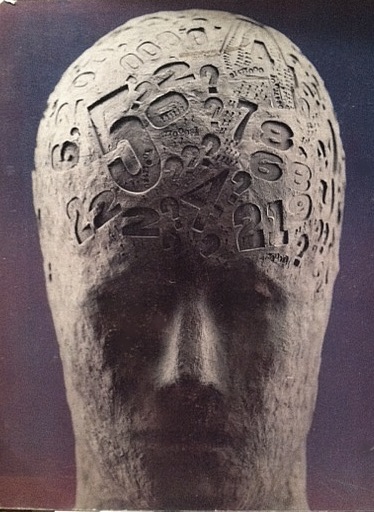
 Sculpture by Jack Gregory / Photo Credit: Seymour Mednick

Hey Drew,

Well you died last night. Time of death, 10:55 pm, which is to say, 22:55 hours. A nice balance of numbers. For a final act, it was very thoughtful. A pair of evens, a pair of odds, both multiplied by a prime number, itself a pair of ones. Very thoughtful indeed.

This comes 10 months and 4 days (10-4, message received) after you entered the hospital and fell into a coma on July 4th, 2011, which is to say 07/04/2011. Add the 7 to the 4, split the 2011 and the whole thing looks like this; 11 20 11. Nice.

You died 129 days into the year, on May 8th, 2012, which is to say 05/08/2012, but only because it’s a leap year. Any other year and it would have been the 9th. When my time comes I hope to die early in a leap year too. Avoid the whole election cycle. Campaigning, primaries, debates; the whole thing. A wise choice and I’m glad you brought it to my attention. Also, I like that adding the individual numbers of your last day, 0+5, 0+8, 2+0+1+2, gives us 5 8 5. So much symmetry.

I’m pretty sure if I start tampering with the numbers surrounding your death I’ll be able to squeeze out a winning lottery number. I won’t know which one to play until after the drawing so it will be meaningless but that never stopped anyone from assigning significance to coincidence.

I guess you would have been able to see where I’m headed with this.

Numerology. Astrology. Phrenology. All the bed wetting pseudosciences.

Numerology is the belief that numbers have occult significance. That there is a divine and arcane relationship between numbers, counting and life.

Numerology touches on the infinite and that, I suppose, is it’s appeal. The assumption is that numerical coincidence is more than just coincidence and that somewhere in that infinity of possibilities there must be an explanation for everything. It’s pure bullshit of course. Anything can be proven if you start with a false premise because it closes the system around your answer. You can’t ask a question from inside this bubble and expect to get anything but your own foregone conclusions. You might just as well ask, “Why do birds suddenly appear, every time you are near?” The only possible answer is that “Just like me, they long to be close to you.”

Let’s take a line. Our line may stretch out to infinity in both directions but that doesn’t mean it encapsulates, or even touches on, anything at all. Infinity is not everything. So understanding the infinite is not really that helpful in determining what to do in the here and now. It just goes to show you the desperate measures people will go to, in order to avoid the obvious. Some things, like death for instance, are not explainable beyond the fact of being so.

Many people believe that you can know the mind of god if you can tease out the numerology supposedly imbedded in the testaments, the stars or the roulette tables. This belief presumes that god has absolutely nothing better to do with eternity. It also suggests that god has a special love of puzzles because, you know, god just loves to fuck with us. All of it amounts to one more instance in which people think that the answers to life’s riddles are obscured and require someone else, an “expert” (with powers far beyond those of mortal men) to do the interpreting. Enter the prophets and charlatans. A core of self doubt will have you believing that a traveling salesman has insights that are not available to you directly, through observation and a little common sense.

It seems probable that this belief in obscurity is, itself, the problem.

But people always seem to need an expert to tell them how to live and what it all means. They say the definition of an expert is:

Someone From Out of Town

The assumption here is that not only are the people we know uninformed but so are we. Well Drew, at this point, no one is further out of town than you. The shame of it is that you and all your neighbors at Montefiore Cemetery have all the answers; the whole meaning of life. Ordinarily the problem of communication has stood in the way of insights from beyond the grave but that may be our shortcoming and not yours. Maybe we aren’t attentive enough.

I live a few blocks from historic Green-Wood Cemetery and let me tell you, there’s a lot going on over there. Eight generations of inscriptions speak to us. The husbands and wives who die within months of each other. The graves of children; small in the past when infant mortality was high but large now. There is wisdom out here among the marbles.

I was thinking about all these things as we got you to the cemetery. Why we think there is sense to be made. The cause and effect of life suggests that there should be something learned here about death but again we are misled by our own assumptions. Life and death are not math. You don’t tally the days and come up with a cumulative answer based on a system of checks and balances. 2+2 do not equal 4 when tallying a life or probing for the meaning of death. The complexity of an individual resists that kind of reductive reasoning. But seen from just a few steps away, there may be something else; something unexpected, something overlooked. So often the answers appear to be obscured because they lie directly in front of us; cloaked in a veil of simplicity.

At graveside, I was reading the stones around you and I have to say that good fortune has put you in good company. Right behind you, a few stones away, is a dark granite headstone belonging to Seymour “Sy” Kamens. You cant miss it, it’s the only dark stone there. Sy’s epitaph reads:

“He Lived While He Lived”

Sy died a few months shy of his fiftieth birthday but his inscription takes us out of the box (so to speak) of evaluating a life and looking for meaning, and reminds us that the meaning is intrinsic and needs no further explanation.

Que Sera Sera

Hey Drew,

My wife had to work last Saturday and so did Charlotte, the neighbor across the street. Her husband Chris was left with their two girls Miranda, 5, and Kendal, 7. They are a mixed race couple, same as us. Chris had six tickets for a members only event at the Brooklyn Zoo that included free rides on the restored Brooklyn Carousel as well as snacks and events at The Lefferts Homestead, an 18th century farmhouse. Chris called with the invite for me and my little guys Cole, 7 and Miles, 8.

I guess you can see where I’m headed with this.

Two middle aged white guys with four kids of color in tow. Two boys, two girls, two men. Gay! Pretty much guarantees that you’ll be ignored by the single mom’s and all the dads. Couples are occupied so you become a magnet for married moms, alone with their kids, looking for a gay guy to girl talk with. I let Chris field the heifers while I kept a laissez faire eye on the chilluns and watched the neurotics. It’s always fun to watch today’s parents molding tomorrow’s psychopaths. I try to keep a positive spin on it.

There isn’t really much to tell about the event. The zoo had animals; the big hit was the baboon’s ass. Bright red for reasons that only another baboon could fully appreciate though the kids came in a highly vocal second. The homestead had old fashioned handmade toys for kids to try, like 6 inch wooden stilts. I mean, what is the point of stilts that don’t make you appreciably taller? I guess when you’re under 4 feet tall, 6 inches is a big deal.

“Look at me dad, look at me! I’m a giant!”

The boys had them pretty well mastered in a few minutes, the girls wouldn’t go near them without crying. The kids are too old for the storytelling circle and too young to appreciate the house, built either in 1777 or 1783 depending on your source. It has a sloping concave roof with wooden shingles. There is a photo of it being moved across Flatbush avenue into the park about 100 years ago. In the photo there is a slowly cresting wave of brick houses and low rise apartment buildings creeping up the blocks on all sides. Blocks that didn’t exist when the house was built. Blocks that aren’t even squared to the lot the house sits on. The house seems dropped into the scene like Dorothy’s house into Munchkin Land.

The photo was taken at that moment when it wasn’t clear who the intruder was in the situation. Were the buildings overwhelming the pastoral scene or was the farmhouse getting in the way of progress? I guess the answer depended on whether you were standing on a porch or a stoop. Oddly enough the loser in that battle is the last one standing. Many of the new buildings in the photograph are gone now, replaced by apartment blocks only a generation later. The remaining ones have been stripped of what little dignity they originally possessed; glassed over and turned into cell phone stores, roti shops and cheap clothing outlets. Down the street, a few steps into Prospect Park, under the maples and sycamores, the homestead has its dignity and its porch intact.

And then there was the carousel. It’s an old beauty and as it is a device that goes round and round it’s purpose is to make you want to puke. Coleman was a little intimidated by it and wanted to sit on a bench instead of on the back of one of the horsies. As luck would have it the benches were few and taken so while the others rode, Cole and I sat out and watched. As luck would also have it the other kids wanted to ride again and Chris was looking a little green so we slipped into the cool vinyl couch of the beast, with brave faces and a nervous belly.

I never used to have this problem. When I was a lad I used to go on a ride called The Zipper. To my mind the reasons for calling it The Zipper aren’t entirely clear. I think it probably should have been called Vomit Now. This would have been the very early 70’s and the carnival was on the lower fields of Grey Nuns on Old York Road. The carnival was designed to take the small change from the kids and keep them busy while the adults played illegal slot machines up in the school. The slots were arranged in an oval with their backs open to the center where the operator could keep an eye on the innards. Whenever a machine was about to make a colossal payout a nun would come over to the machine, graciously ask to jump the line, take the handle away from the player and start jacking coins down the slot. Within a pull or two she would hit the jackpot, scoop up her winnings and walk away from the adoring parishioner she had just ripped off. And the adoring idiot would just marvel at the sister’s good luck. I swear it’s true. First hand knowledge. I was sitting cross legged under the table watching with my friend Richard as we were digging dropped quarters out from between the machines.

The Zipper was basically a dozen tipsy cages spinning on a pair of drive chains that were rotating around a parallel pair of 40 foot propellers that where spinning. Rated number 1 on any carnival ride shortlist, every description of it is priceless. I have only just now learned from Wikipedia that I was riding the pre safety improved model. Improvements came in ’77 after a hefty number of gruesome and litigable accidents. It is, in fact, hard to think of any description of this ride that would even remotely suggest that those injurious outcomes were anything but deliberate. I urge you to have a look at the Youtube clips of it and then consider this little gem of a fact. The stripped down model I rode turned about 40% faster.

Ordinarily I am loathe to use anyone else’s writing beyond the length of a short quote but this entry from another web site is just too precious to pass up.

# 1 Ride – The Zipper

Truly the most metal of all the amusements – the Zipper is King of Kings amongst carnival rides. No matter where you are, in any state, in any town, the Zipper ALWAYS guarantees you the following three things:

1) The most insane, scary, drunk and high ride operator in the entire fair

2) The largest line, consisting of more middle schoolers smoking cigarettes per capita than anywhere else in the nation

3) The ONLY ride that gives you both a 10 in Fun and a 10 in Likelihood of a Fatal Accident.

The Zipper rules all that comes before it – a 48 foot tall beast, where the only thing preventing you from meeting an untimely demise is a two inch long pin, that’s half an inch in diameter. The ultimate deathtrap, the Zipper rewards those brave enough to look past the squeaking, creaking, and falling of integral pieces with an incredibly intense riding experience that changes every time you go on. What’s that clicking noise? No time to think about it – you’re being hurled head first toward the pavement. Is that a screw that just hit me? Doesn’t matter, because we’re going BACKWARDS, baby.

Nice right? Not anymore. A 99 year old carousel is now an alarming prospect. I’m sure it’s partly mental but still, after I turned 40, everything that could make me dizzy did. After I turned 50 even the mirror became disorienting. Then again that may be another story.

So there I was, facing down the hellish, nauseating threat of the carousel. The platform spinning round and round. The horses going up and down. And only two padded benches for the cowards. The merry old gentleman operator, a clever disguise for the roaring soul eater. He whose name must not be spoken. For a reckless torpedo of a kid, Coleman can have extraordinary moments of fear over the most mundane events. In retrospect, it was less like fear and more like shyness. As if a formal introduction to the wooden horsies might be all it would have taken to dissipate his anxiety. “Coleman, this is Sea Biscuit. Sea Biscuit, this is Coleman. You two are gonna be great buddies”.

I know his anxiety must have been on my mind because as the carousel started turning and I began testing myself, successfully, as to whether I could make myself dizzy I started to look for stable points for us to focus on. I started by pointing out the music maker. A one man band, minus the man, called a Wurlitzer Band Organ, it sits on the blacktop, unmoving, in the central area along with the drive motor and operator, the carousel spinning around them. Opposite the Wurlitzer there is a bare breasted caryatid, her arms draped languidly over her softly quaffed hair. Her breasts are high and her nipples suggest that she was carved on a cold day. A surprising addition really to a ride that dates back to 1912, and yet it doesn’t look at all out of place. Personally I  think they should have one like her on every street corner in America.

Now we’re picking up speed; pushing I would guess 6 rpm maybe even 7. I need a strategy, a game-plan to get us through this. Or maybe just to get me through this. When you look towards the center of a spinning object, as we did with the fulsome caryatid, you are looking at the slowest moving part of that object. If you are seated on that spinning object it’s a pretty good tactic nausea avoidance-wise. Better yet is to look at something else on that object that is spinning with you. As a matter of relativity you are now standing still, centrifugal forces aside. But staring at my hands is only going to alarm Coleman so I look up and I see the very slowly turning crank. The horsies that go up and down are not pushed up from below they are pulled up from above by a driveshaft with offsets like a hand cranked drill laying on its side. As the shaft turns these offsets describe a small circle. The crank passes through a sleeve at the top of the pole that carries the horse up and down and the pole slips up and down in a guide mounted to the floor of the carousel. Cole is either very interested in how this simple mechanism works or he is too petrified to resist my guided tour. Either way the ride is soon over and as the last strains of Que Sera Sera played by organ, xylophone and drums fade away I can see he’s ready to ride again.

Saturday Morning Cartoons

Hey Drew,

Let’s Pretend that it’s story time

And I’ll tell a tale to you.

I’ll tell you a story of make believe

And all your dreams will come true.

And when the story’s over

And when we reach the end.

We’ll live happily ever after, Where?

In the land of Let’s Pretend.

I guess you can see where I’m heading with this.

That guy, Gene London, early 60’s, singing to us on the television on saturday mornings from Cartoon Corners General Store was telling us that there is a better place than where we are. And you know what kids? It’s in your mind, man. The part that is really impressive man, is how we will live happily ever after in the Land of Let’s Pretend, after the story is over man. After! We are goin’ out there man and we are not coming back man and it’s gonna rule man! I shit you not Drew, that guy was a stone cold freak. No wonder we loved him.

You know the story. In the not too distant past a kid joined the family business, was apprenticed to an acquaintance or simply sold to a stranger. Life was simpler then. Our generation was, to a greater degree than ever before, free of those constraints. Consequently, of course, we were also free of that iron fisted guidance. But television abhors a vacuum and guidance appeared in the form of televised animated role models. And if you take a second look at the messages we were getting man, they are a glorious trail mix of fruits, nuts and seedy characters. The old wicked was a new viable alternative lifestyle.

In the old days man, in the old days the old allegories hammered home the old values. You see, the message of fables and fairytales was that if you stepped out of line you were dead meat. Killed, cooked and cannibalized by an unforgiving natural order. And we remember those stories but it didn’t end there with us. We bridged the past perfect and the future shock. Fractured Fairytales was our New Testament and it revealed to us that the past wasn’t so perfect and the shock was more like a delightful buzz.

We were the link between the Brothers Grimm and Warner Brothers. From Mother Goose to Merry Melodies from Mothra to Hanna Barbera we watched it all. We were the passive aggressive receptors in a psych-o-social mind fuck.

Huckleberry Hound, Drew. Huckle fuckin’ Berry Hound! Need I say more? That dog had his paws deep in the shit, noooo doubt!

Underdog, man. When Sweet Polly’s in trouble I am not slow! The rest of you can go scratch yer ass cause Polly wants more than a cracker, you know what I mean man? Bird is the word man. Bird..is..the..word!

Casper the Friendly Ghost? Great. Really great. You tune in to turn on to a little scare me time, a little adrenaline rush and what have we here man? What a little apple polishing, boot licking, brown nosing, goody two-shoes! No wonder he’s a ghost. I’d pop a cap in his ass myself. And you know he’s such a transparent suckup. Really makes you think twice about being a good guy. I mean, if he’s a member of the crew your hangin’ with, you need to get yourself a wolf pack and go wilding.

Bugs Bunny, amigo! Come on!! Now there is a hometown homeboy! There isn’t a soul alive or dead who doesn’t love Bugs Bunny. Cross dressing, Fudd kissing, carrot obsessed, sarcastic flamboyant bitch. A role model for millions man. Undeniable!

Mickey Mouse? Nice guy. Kind of a chameleon. Trying to be all things to all people. Genial, with a castrato’s voice. I think I liked him best when he dressed like Bing Crosby. Cool yet wholesome. No undercurrents. Minnie was pleasant enough; a female without allure or any sexuality what-so-ever, which is saying something. They were like warm broth. A pair of role models we might choose for our parents but for ourselves? No way man! Ain’t happenin’!! They didn’t know how to have a good time. To them fun was exciting and a little scary. No man, for us it was Goofy, man. Fuckin Goofy! The dude didn’t know how to have anything but a good time. Goofy was the man, dog! He could have the best time ever just trying to figure out his own shadow. I can just hear my old man saying ” who would look up to a character named Goofy?” Silly question, right? The answer is “Me! You! Everyone”! When we were kids you had to have a nickname. To this day my three best friends are, Dink, Funk and Zonker. Say no more, por favor.

Road Runner? I don’t know man. Everyone I know would rather be Wile E. Coyote. Wile E. was the Don Quixote of murderous stalkers. I’m convinced he pointed the way for a generation of punk bands and paparazzi.

Popeye? Smoking, cursing, muttering, substance abusing, twisted freak of a snap case.  I’ve had all I can stands and I can’t stands no more. What’s not to love?

Foghorn Leghorn, Drew! Freakin’ Foghorn freakin’ Leghorn. Without a doubt among the most imitated of all characters. Drew, we were all emulating a chicken! And not just any chicken. A stuttering, conniving, lazy, shit stirring common domestic fowl (Gallus gallus) with delusions of grandeur. Who could resist?

Mr. Magoo? Forest Gump meets Foster Brooks. There’s a little Mr. Magoo in every stoner I ever met.

The Pink Panther? Pretty much self explanatory.

Woody Woodpecker. A name is like a picture without the image. Woody was playing in the same league as Beaver Cleaver, Peter Parker, Pat McGroin, Ashur du Smelbad, and I.P. Daly. Also the theme music was a big hit for Kay Kyser’s band in 1948. The band featured the cornetist comedian Merwyn Bogue whose stage name was Ish Kabibble. True fact, man.

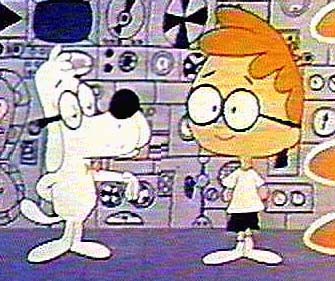
When I was a kid I had a best friend. So did you and everyone else. The same held true for cartoons, right? It was match.com with a no divorce guarantee. Chip ‘n Dale, Heckle and Jeckle, Tom and Jerry, Beany and Cecil, Rocky and Bullwinkle, Fred and Barney, Sylvester and Tweety, Sherman and Mr. Peabody. Secret Squirrel and Morocco Mole, Tennessee Tuxedo and Chumly, Augie Doggie and Doggie Daddy (“Auggie my son, my son”! was that Jimmy Durante?) Libby the Lion and Hardy Har Har. Yogi and Boo Boo, Touché Turtle and Dum Dum, and the legendary Quick Draw McGraw and Baba Looey. I’ll do the thinnin’  around here Baba and don’t! you! for! get! it! Nobody ever loved a dim bulb better than we did.

Who’s to say who we’d be without the likes of Clutch Cargo (featuring real lips), the weirdo marionettes of Fireball XL5 and Thunderbirds and the final morph to H.R. Pufnstuf and The Banana Splits. These last two may have been live action shows fronting B grade toons but they were hosted by fully costumed, foam filled, fun furred, day-glow stoners. Gene London on acid. Two hits! By this time the kiddy gloves were off and the smoking jacket was on. I mean really man, H.R. Pufnstuf? That is, without a doubt, the name of a head shop somewhere!

Refocus man, refocus. What was the question? That always happens man. I get off, on these tangents, and the next thing you know I’m at the refrigerator door looking for a snack and, oh yeah, Saturday Morning Cartoons. So look, there are big issues here man. Big issues. Like was Crazy Cat really that crazy or was he just a product of his environment? For that matter was Felix the Cat really happy or was he just putting on a brave face. The facts of fiction are inscrutable man. And why so many cats and dogs? And mice too. Speedy Gonzalez had a totally positive mental attitude sure but I think it was the amphetamines. When he comes down he’s gonna be a high speed train wreck.

Top Cat; lazy, scheming, fancy-pants hoodlum. Gang leader of a ragtag band of miscreants. As if all that wasn’t enviable enough he had an awesome theme song. When I was growing up you had to have your own sound track because every character had their own sound track. And T.C. had street style. So we needed street style. In my school that meant you had to have your own walk. And a walk sticks. All these influences stuck. People I know can tell it’s me walking down the street before they can identify my face. The walk is so distinctive that it arrives before I do. I am aware that’s probably not a good thing.

Obviously Mighty Mouse was mightier than the Mighty Manfred, sidekick to Tom Terrific but Manfred was the man that Fred wasn’t. Fred, sidekick to Super Chicken, who wasn’t all that super but did take his Super Sauce Elixir in a martini glass, had to be reminded that he knew the job was dangerous when he took it. But then, that’s why we all picked up the martini glass in the first place, right?

Look, I could go on and on but all I’m trying to say is that George Jetson’s dog is Astro and Astro Boy is a robot who wants to be a real boy and Pinnochio is a wooden toy who wants to be a real boy too. Not a big issue for Pinnochio because he lives in a world with magic which is really a bullshit plot device. There is no magic in the future so Astro boy, who can live forever, will be disappointed forever. Dude needs to adjust his expectations. Meanwhile, Tobor the 8th Man was just Robot the 8th Man spelled backwards but he had no desire to move beyond his station in life. He was basically Iron Man without the man, man. Lacking desire maybe he should have been Tobor the 8th. Done! Give him the benefit of the doubt? I don’t think so. Takes us into murky territory. Makes the connection to Henry the 8th, I am, I am, as in I am Sam. Sam I am.

I Am. Two words. Three letters. The most powerful statement in any language. Self determining. Self referential. Bottom line? Deputy Dawg was not a real officer of the law, bro. You know, that’s all I’m trying to say.

I Hear Voices

I have this friend. We’ll call her Melissa Stern because that is her name.

Melissa Stern is a sculptor and a brave, or perhaps foolhardy, one because she has allowed others to tamper with her work. I am one of those people so perhaps temerarious would have been a better word but I don’t know how to use it in a sentence.

One of the reasons people become artists is that it gives them ultimate control of the universe; even if it is only the universe of their work. It is a godlike responsibility because, as Uncle Ben would tell the youthful Peter Parker shortly before being offed by a criminal; “With great power comes great responsibility.” As we all know, Peter’s initial indifference to crime, even as Spiderman, caused him to decline the chance to stop a fleeing thief. His apathy caught up with him later the same day when the same criminal killed his Uncle Ben during a burglary. Oh,The Irony!

Melissa Stern, in her role as god, has created woman and man. Seems stereotypical doesn’t it. A requisite skill; indispensable for any deity’s curriculum vitae.

~~~~~~

“Ok, have a seat. Let’s take a look at your resumé. Stars in the sky; Good. Animals of the land; very nice. The giraffes are an especially nice touch. Fish of the sea; check, Plants; good, a lot of hidden drama there. Very nice. You do nice work. So, let’s see your people.”


“Hmm?”


“What do you mean you don’t do people?”


     “What are we talking about here!? It’s not ethical!? It messes up a perfect system!? What!? What’s the issue!?”


“I see. They’re not part of your idiom.”


“Ok, ok, well look, it’s been a pleasure. If anything comes up we’ll give you a call.”


~~~~~~

Melissa Stern’s people have the disconcerting quality of looking on the outside, the way people are on the inside. Conflicted, misunderstood, innocent. 

Stern has put together a collaborative, interactive exhibit. She asked some writers to choose a sculpture and write a monologue from the sculpture’s perspective. Reckless on her part; like inviting another deity into your universe on a per diem basis but admirable nevertheless. An act of faith. I am fortunate because I am her friend and because she allowed me to choose the piece about the death of her father, Bernie.

The monologues were recorded and each sculpture has been tagged with a QR Code so a smart phone can play the reading while you look at the work. Viewers can also add their own comments that are then available for playback.

I wrote the monologue from the perspective of the Willy Loman character schlepping across the girls head.

*

She was Juliet. I was not Romeo.


More like Odin the wanderer.


I was no hero but to her. 


At dawn, I would perform my morning ritual and then … disappear. She thought it was magic. I thought it was my job. I didn’t know what else to do. Then, at dusk, I would reappear to rescue her from the night.


Magic!


She was beautiful. Not like scary beautiful. More like beautiful girl who liked me, beautiful. I couldn’t stop looking at her. She was an innocent. And for a time, we had each other. “Forever!” she would say.


We had hopes. Like everybody else. Special and mundane. I hoped she would be happy; she hoped for the moon. We lived in tenements and apartments all over this town. We cooked and did laundry; and went to see movies and theater and music. Moving. Restless. Together under all those different roofs.


The magic was between us. She thought that would be enough. I knew it wasn’t. I was the grown-up. I could never bring myself to tell her. I didn’t want to break her heart. I knew it would break, in its own time, of its own fragility. And when it broke, I knew that I would be one of the pieces; brittle and sharp.


A fragment is made new by its incompleteness. A shard is not an urn. It is a new memento of something old. Once broken it can never be called broken again. I preferred it that way.


Of course I had to leave. It was the only way. The only way I knew. So many years getting up. So many years washing my face; like an act of purification. Dressing, collecting my .. self, walking out the door. Out. Ever out.


I had to leave. It was the only way I knew.


*

For the reading by Michael Samuel Kaplan follow the link below

 http://melissa-stern.com/gallery/imagegallery.php?subdir=The_Talking_Cure&numb=2

Tick Tock Diner

Time, so they say, is irreversible. The Past, so they say, is different from the future.

Time does not stand still.

I went to college for seven years. Even so, I am at least a couple of years away from a Bachelor’s Degree. My freshman year was three of the best years of my life. The same could be said of my sophomore year. So much for the vaunted rules of time.

One of those sophomore years was spent at the University of New Hampshire. I lived in a house with 15 other people. We each had our own room of a divided up old Victorian. We shared three bathrooms and two kitchens; one on the ground floor and one on the third floor.

The ground floor kitchen had several refrigerators. We each had a section of refrigerator but my friend Dave likes to tell it that when I was hungry I would, in his words, forage through them all. Forage is his word now. I can’t think it or say it without making a mental note of him.

For the record and in the interest of fairness my friend Dave disputes many, if not most, of the facts in this story. However, since I am the writer, I would like it known that Dave is a notoriously unreliable, not to mention uncooperative, witness. Furthermore, during this time, Dave was a degenerate drunk, an unrepentant sybarite and a known communist sympathizer. And it is This Reporter’s Opinion that he also practiced….. WITCH-CRAFT!

That said, I don’t recall if I treated all those refrigerators as my savannah but it’s entirely possible. I still eat that way when left to my own devices. I’m less of a hunter-gatherer and more of a scavenger. An opportunistic eater one might say.

Apparently I was able to avoid drawing predators, in the form of angry housemates, by employing a survival mechanism that I like to call Nibble and Move. Pretty self explanatory and altogether successful when coupled with the track covering behavior of fluffing the refrigerated leftovers to camouflage my covert snacking.

The upper kitchen was outside of my natural habitat but not outside of my interest. I used that kitchen to boil road kill that my Anthropology Professor had buried for a season. You know, to get the last furry bits off. He was making a skeleton collection of local fauna. I don’t know what I was thinking but I’m afraid I thought it was a good idea. His name was Howard Hecker.

When Howard and I first met he said ”Mednick eh. Are you related to the poet Mednick?” I answered that I thought it was possible but probably not. Then he asked if I knew Hecker flour and of course I did. Even back then, barely nineteen, I occasionally baked bread. “Yeah” he would say, “I’m not related to them either.”

One of the fellows who lived in the house was named Robert Armstrong. “All American Boy”, my mother would always say when hearing his name. Surprisingly, his was not the most memorable name. That belonged to the birdlike and serious Cat Sleep. A definite top floor turret dweller, she lived in the round room. She was serious, industrious and motivated. A genuinely diligent student, she would make any professor proud. We shared nothing in common.

Over Christmas break, Robert Armstrong, “All American Boy”, had moved out and now lived at another house out in the boonies between Dover, where I lived and Durham, the town where the University was and I presume still is. That house was called Shaky Acres and every full moon was occasioned by a Full Moon Boogie, after the song of the same name by Jeff Beck. I can no longer remember how many of those Full Moon Boogies I attended but whatever the number I can only recall one. And of that one I remember nothing. I don’t think it was because I’d had too much to drink, although chances are pretty good that I was drunk, but only that so much time has passed.

Everyone thinks about time. The great distance between then and now. Where does it go? Whatever happened to my dearest what’s her name that I loved so well? How did I become here? How did I get here is a question of time as much as circumstance but adds the fleshy dimension of history and the question of free will.

History is the accumulation of events. Events exert pressure on subsequent events.

Pressure subverts free will.

My friend Mike is a city planner or would be if he weren’t working for the MTA. There was no work in city planning and after years of trying he settled for the MTA and a steady meal ticket. Mike’s family came from Ireland in the 1840’s, driven by the potato famine. After passing through New York harbor they joined the push west to Ohio and opportunity. And then on to Illinois. Failed farmers they joined the California gold rush. And then north. And then back east to Chicago. Finally settling down in New York, the very place they had departed more than one hundred years earlier. A trip of generations in search of a bite to eat.

Were they really making choices or were they pushed along by the force of history? Is it free will to follow a trail of survival? Are any of us exercising anything more meaningful than the choice between low fat and skim, caf and decaf? It’s the past. The past propels us forward. Again and again we steer blind but experienced, into the headwinds of the oncoming present, looking for calm and a cessation of hunger.

A Thought for Your Penny

Memory is a funny thing and for pretty much all the reasons that everyone says. It’s selective and subjective, cherished and requisite for a good liar.

My father, a photographer, once or probably twice since he never thinks I listen the first time, told me that we remember colors in reverse. The color we remember an object being, is likely to have been its compliment. Which is to say we remember colors by their contrast. An interesting idea since it suggests that memory is as much about remembering what a thing is not, as much as by what it is.

I remember three of my father’s photo studios. The earliest was over an appliance store called Nate Ben’s Reliable. I was very young, no more than three or four years old, and as I recall the place had no ceiling. Every surface had been painted black for better light control. The walls seemed to rise on up and disappeared into the night sky; into outer space but without the stars. In that studio it was always nighttime. It was always a moment before the big bang. All potential.

A visit to my father’s studio meant play time in the prop racks; trying on clothes and looking for treasures. There was one prop, a giant horse-shoe magnet, that was too large for the prop area. The magnet, in reality just plywood and paint, was left over from a Smith-Kline Pharmaceuticals shot for a children’s iron supplement. This was back when vitamins were pitched to parents instead of directly to kids via cartoon character shaped pills. The giant magnet was always around but never in the same place twice. Slowly orbiting the studio it was, I imagine, a force of creation; emitting invisible fields of attraction and repulsion.

The studio was a place where time moved in uneven intervals. Eons would pass; nothing would happen. And then, without warning, all the lights would go out. You were suddenly alone, afloat in the blackness. The strobe lights would flash, POP, and you’d be blind for a moment from the whiteness of it all and that meant a new universe had been recorded on film.

After everyone’s vision cleared, my father would jockey people and props around; darkness and then, POP, another new universe would appear on film. He always said that being a photographer was a lot like being a salmon. You shoot frame after frame, roll after roll like a salmon laying it’s thousand eggs in the hope that one survives the jaws of the art director.

Things were always getting lost in my father’s studio. Lenses, props, bills, wardrobe items; nothing got lost as much as the prints themselves but nothing got lost forever. Eventually a finished print would show up, sometimes weeks later, and the key thing was that you had to grab it when you saw it. Even if you didn’t need it at that very moment. A mental note of its last known location was not enough. These sightings were random and fleeting. Like some rare and endangered sea mammal it would surface for a breath and then disappear. You captured it right then and right there or it would be gone again and for how long nobody could say, submerged as it was in the chaos and clutter of a busy studio and a creative mind.

My job in heavy construction shares some of those qualities. There is always a lot of old stuff where I work. When you are doing excavations and building foundations you necessarily have to dig up the past. Old building foundations, old piers and sea walls; a reminder of the shifting contours of this island and the evolution of land usage. In an old city like New York the past is always getting in the way of the future and while sometimes it can be worked around or even incorporated into new designs, more often than not it has to be removed and sent to the dump.

Not so long ago I was working in a hole in the ground burning a pipe pile. The pile, full of reinforced concrete, was for a new building foundation. It was a 48 inch wide pile with 3/4 inch thick steel walls. We were burning the last dozen feet off to bring it to proper grade for the pile cap; the part that ties the piles to the building itself. 48 inches might not sound like much but that’s the diameter. The circumference is near 13 feet so we work in pairs. My buddy Matt was burning from one side and I was burning from the other. Whenever I’m asked if I can burn I always say I’m adequate. In reality I am very competitive and proud of my burning. I’m not always the best but I’m always in the running.

Burning, like a lot of things, is actually several events encompassing a wide range of skills. You don’t always cut flat plate and you don’t always cut flat. You cut rust, which is not only time consuming but painful because rust doesn’t melt. The good steel melts and the rust causes the red-hot slag to spray back at you. In burning, as in working out of doors, it helps to know how to dress and also to have a fairly high tolerance for pain. But it’s okay. It reminds you that you’re alive.

There is also burning an object at or under the water line, which is either fun or incredibly irritating depending on tidal issues. And then there is burning a non-hollow object. In this case a steel pile full of reinforced concrete, as I’ve said. I’m pretty good at this type of cutting and was well ahead of Matt when I looked up to change positions. If you’re not comfortable, you aren’t going to burn well so you should be changing hand or body position almost constantly.

There was a pool of muddy water to my right and a wet embankment in my face. To my left was the pile. I had put a piece of lumber in the water and was leaning into the pile while balancing my toe on the slightly submerged scrap timber. When I looked up there was a disk on a little outcrop in the embankment. I picked it up and figured it was a washer but then there was no hole in the center so I slipped it into my pocket. As I was standing with the pipe drillers a short time later I took it out to have a closer look. It turns out to be a coin of some sort. I scratch it clean with my wet fingernail and it looks like it says…. let’s see.. ONE …uh..C*NT. ONE C*NT. Well how do you like that? It must be an old token from a Times Square peep show. Even so, that seems a little harsh.

Then I turn it over and there is a lady’s head with a banner on her brow, which reads LIBERTY. Wait a minute! That’s not ONE C*NT, it’s ONE CENT. ONE CENT and this thing is old! It’s scraped on one side where the back hoe bucket must have caught it but only three of the original thirteen stars are missing and it says 1883 or is that 33? My eyes are too gone to tell. But yes I’m sure it’s 1833. One of the crane operators says his brother collects coins and proceeds to call his brother who takes the info and says he’ll call back. He calls right back and tells us that it’s worth between 5 and 25 dollars depending on condition.

At home I get out a photographers magnifying loop, a souvenir of my father’s studio, and sure enough it’s 1833. When I showed Matt the next day, he said “Hey look! That head is the Statue of Liberty” which of course would not exist for another 50 years. I, of course, told him. It’s rare that I can correct Matt without his wanting to kill me but I know it’s all affection so I don’t normally worry too much. I just suffer the arm punches with as much good humor as I can muster and a very modest amount of internal bleeding. A couple of days later I showed the coin to my German friends. In 1833, Germany as a state would not exist for almost another forty years. My German friends didn’t think that was particularly amusing.

And here it lay, not only at the tip of Manhattan but in the landfill behind the crib wall that formed the southern seawall in the 19th century. Not only that but I found it in this triangular pit about 60 feet on a side. It is the confluence of the old 1/9 subway line turn-around, the FDR to West Side Highway tunnel and the N and R trains. And water mains. And gas lines. And air shafts. How had it not been found before? This tiny parcel of land has been turned over like a fertile field dozens if not hundreds of times. This is made land. Nothing of it exists except by the hand of men. And I do mean men. As the guys like to say “If it was easy they’d have the ladies doing it.” Sexist yes but fundamentally true. There are no girls out here although I have heard of some with the termites; the carpenters. The lone female is the sister of my foreman and on the job friend, Alex. Alex and I would never meet socially; he’s devout catholic with all that implies, and I am lost cause. Third generation Dockbuilders; she’s the exception that proves the rule. Or disproves it. Your call.

But anyway, you get the idea, it was old and here. Right here in the dirt. And always had been. Or had it? Was it picked up from somewhere else? Part of a ground up building or excavated soil recycled into landfill? The past becomes the present becomes the past. You know there is a market for landfill just as there is a market for land. What do you think landfill is? It’s land!

And how did it get here? At the end of a concrete pour you will often see a laborer toss some money into the wet mass. An offering to god. Thanks for not letting the form blow out. Was that it? Or did it fall out through a hole in someone’s pocket; the better part of an hourly wage, all that time ago. Who’s hand did it touch last? How did it get here?

How? I’ll tell you how. It was dumped by circumstance.

So, is that the meaning of it all? Is that all that it means? This penny?! This penny had evaded capture for over one hundred and seventy years to get to my hand. It is why I prefer used books. It seems like you don’t find them, they find you or better yet you find each other. Forces of attraction guiding small changes in direction toward an ultimate goal. Like all the history of the world has led up to this meeting. This utterly meaningless meeting.

This singular moment, this pointless event, will probably not echo in eternity but it does remind me that the ball is rolling. That weak forces as well as strong ones are at work and that seemingly unrelated events tie it all together. And the penny? I don’t know where it is right at this moment but sooner or later it will surface, like a lost photo in my father’s studio.

Sexy Shorts

It has been suggested to me that my oeuvre does not contain enough sex. I thought oeuvre was French for egg. I became concerned because I didn’t know how to fold that into an erotic situation. I suddenly became worried that everybody knew something about sex that had just completely got below my radar. Then I learned that oeuvre is French for work and it started to make a little more sense.

Prurient thoughts are not foreign to me. Or anyone else for that matter. Be that as it may, I wish the suggestion for sexier content had not come from my 77 year old mother. It’s a little awkward. Everyones parents are sexual creatures but who wants to dwell on that? Still, a person always wants to please their mom.

~~~~~o~~~~~

My maternal grandparents were married for more than fifty years. They met on the telephone. My grandfather was a telephone switchboard operator at City Hall in Philadelphia. This was way back when there were switchboards and operators. My grandmother was calling City Hall on some forgotten mission. This was way back when you could call City Hall. She liked the sound of his voice. They met, had premarital sex and married shortly before the birth of my uncle Gibby.

My grandmother once announced, half complaining, half teasing and entirely without discretion, that my grandfather couldn’t really do “it” anymore. She could be tactless. After his third or fourth heart attack I guess he just couldn’t manage the necessary blood pressure but he was an even tempered man, if you discount the life long gambling binges. His response was “I’ve been fucking for more than 50 years. You’ll see. When you get to be my age, it’s not that big a deal.”

~~~~~o~~~~~

Thirty years after the birth of my uncle, my father caught site of my mother wearing white short shorts, no bra and a tight t-shirt. They were married, after an unusually affectionate courtship, not long before my sister was born. Not long at all.

I can remember waking to the sounds of them talking and laughing. My room was down the hall from theirs. I couldn’t make out the conversation, muffled as it was by doors and blankets on both ends but laughter is laughter. It had all the sounds of happiness and intimacy. Needless to say the divorce, though many years later, came as a surprise but their laughter is still at my core. They lost it for a time but I will always carry it. I have long considered it my most important memory.

~~~~~o~~~~~

My wife is a beautiful, mixed-race black woman. As the kids like to say, “Dad, you’re the only white person in our family.” We kissed at a Halloween party when she was twelve. I had just turned fourteen. It didn’t go anywhere. Where was it going to go at that age? We met again when she was nineteen. It was immediate and overpowering but we were young. We struggled with commitment until marriage and have never turned back since that day. She has a lovely caboose that has grown a bit over the last few years. As love would have it my tastes have changed along with her contours.

We are in our middle years and one day is very much like the next.

It’s the end of the day. The boys are warm and quiet in their beds. A load of laundry is tumbling in the tropical heat of the dryer. Plates and cups are being soaked in the scalding waters of the dishwasher. I shower and get under the covers to read and warm the bed for her, propped up a little by soft pillows. She bathes long. A displaced marine mammal from somewhere near the equator, she is in repose, submerged in the placid, steaming lagoon of our bathtub; grateful for a reprieve from the thin air. She comes to bed, her skin still warm and damp. She lays on her side, her head resting on my chest, one leg entwined with mine. We sleep together and we depart for sleep together. The lights are out and our breathing falls into harmony. I rest my hand on her hip. We exchange a few words of love talk and my hand slips down and around to her lower back. I stroke her soft backside. It’s very quiet. Then the whisper, “I want to snuggle.” It’s not our code. It’s not a secret invitation. It’s our little guy. We didn’t hear his soft approach. He’s ready for love.

OMG

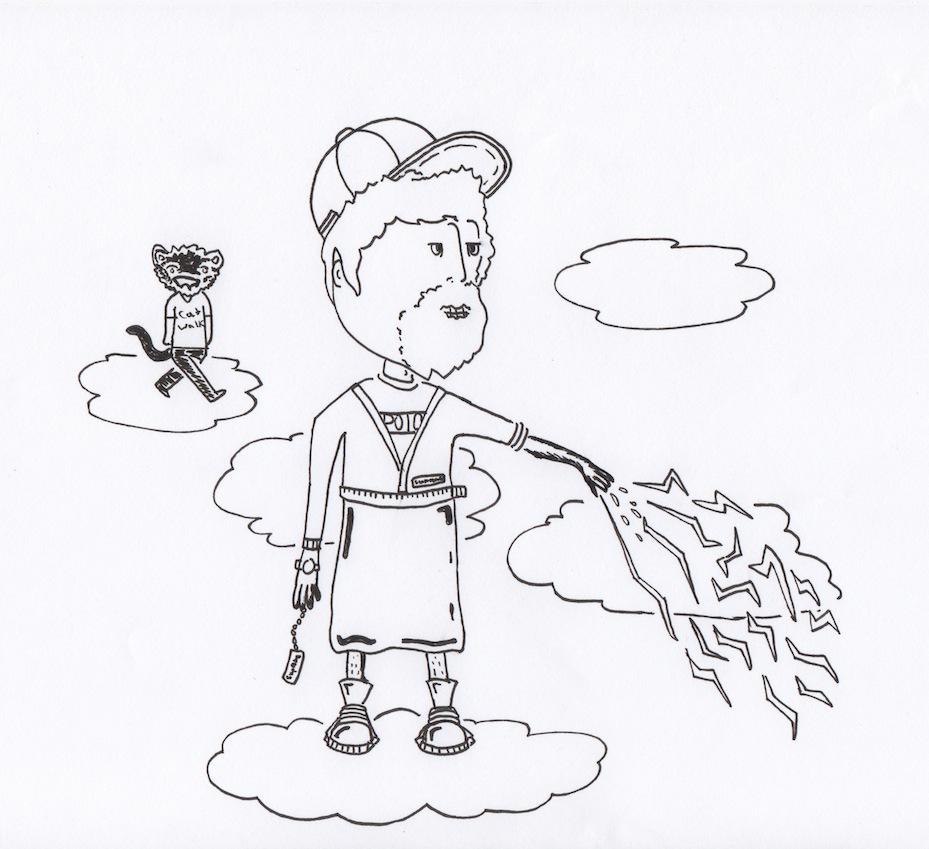
                                                                           Illustration by Clayton Mednick

As you know, I am not a person who goes looking for the hand of god in everyday events. I believe everyday events, by there very nature, are beyond god’s management. I don’t ascribe meaning to random incidents, accidents or unusual combinations of numbers.

Much is made of so called miraculous recoveries from medical maladies but as a matter of statistics they fall well within the curve of possible outcomes. In fact, most of the “miraculous” part is added by people and media looking for the hand of god in otherwise ordinary outcomes. It just goes to show, if your always looking for something to confirm your belief system, then your going to find it.

For instance, people talk about the miracle of childbirth. And you know, if it weren’t for the eight billion people crawling over every square inch of the globe I might be inclined to agree. But really, with over 380 thousand kids born every day and the very function of life being continuity, there doesn’t seem anything remotely miraculous about it. If anything it seems commonplace, even inevitable. Practically mechanical.

Survived a plane crash? So did most of the other people who have ever been in plane crashes. It is rare to the point of miraculous when everyone on a plane is killed.

The Virgin Mary’s profile on a potato chip? You want it? You got it!

9-11? Everywhere you look. Same as it ever was. You’re just looking for it now.

It’s called Confirmation Bias. People tend to seek out, focus on, and remember information that supports their ideas and beliefs while ignoring or downplaying information that contradicts or undermines their beliefs.

Why is it that people thank god for the recovery of a desperately ill child but they don’t blame god for trying to kill the kid in the first place? Confirmation Bias.

It’s why professional athletes thank god for the big win but they don’t blame god for the crushing defeat. Also because cursing god negatively impacts the bottom line of product endorsements. Simultaneous Confirmation Bias about both god and money. Not exactly a shocking revelation.

However, even I have to admit that once in a while my thoughts turn to god when there is a sign with clearly inescapable religious significance. The sign in question was seen by my own self in the sermon case outside of St. James Episcopal Church, 865 Madison Avenue at 71st Street, founded 1810. It read:

Does God Really Give Fashion Advice?

A sign from god? I like to keep an open mind so here we are giving it a little consideration.

It seems to me that before you ask the question of whether or not god gives fashion advice you would want to consider if you would even trust that advice. Sure it’s god but still, you have to be a little skeptical, right?

God and fashion?

(1) Is it Possible? I suppose anything is possible.

(2) Probable? Well, on first blush it doesn’t seem like a great fit.

(3) A good thing? Hard to imagine really.

The question of god being a good source of fashion advice is, admittedly, not the kind of thing one considers very often. I haven’t read the bible but I’m a big fan of religious radio shows. It is no small point of pride with me that I was listening to Harold Camping of Family Radio predicting the end of the world years before the end of the world didn’t happen. It seems to me that Family Radio’s byline “Feeding the Sheep” should have been the mother of all neon signs warning that anything coming across their airwaves was tongue in cheek, hand in wallet bullshit but did I mention Confirmation Bias?

My sister used to have a housekeeper named Ella Mae. Ella Mae summed it up this way; “I don’t know why everybody make such a big deal about the end of the world. Every day it’s the end of the world for somebody.” True Dat!

In all my years of listening to Brother Camping’s gravely voice peel the proverbial onion of scripture I never once heard him comment on the benefits of, or god’s preference for, florals versus checks, pleats or no pleats, wide lapels or narrow. One assumes that god prefers a necktie over an ascot but that’s just an assumption. Collar or no collar? Two button, three button or four button dress suit?  In fact, although I know it to be a mortal sin to wear White Bucks before Easter, I don’t believe that rule dates from the Roman Empire.

Tunic and cloak? There’s just nothing eternal about those threads.

Ok so let’s get back to the source of this conundrum. I’m not familiar with the Episcopalians so I had to look them up. It turns out they are the Americanized Anglicans. When the American colonies seceded from England it was necessary for the churches here to secede from the Anglican church because the Anglicans swore an oath of loyalty to the crown. So if the Episcopalians are basically an English order you have to figure any fashion advice would have to touch on the basics of English taste; namely Paisleys and Cross Dressing. Of course that also casts doubt on the Necktie versus Ascot assumption. Religion is so vexing isn’t it?

But doesn’t this all skirt the issue of expectation? What is it that we want from a god anyway? Is fashion really a good use of the almighty’s time? Isn’t god busy with something else? Anything else? Everything else? As it turns out, not really.

The physical universe is governed by physical laws. These laws are unbending both backwards and forwards in time. Using even our imperfect knowledge of these laws we are able to make accurate predictions about future events as well as accurate predictions about what the past will hold as we unravel every story of creation. It is these immutable laws that make accurate predictions on the macroscopic and microscopic level possible.

So, within the principals of uncertainty, the universe is a predictable system that runs itself. God doesn’t really need to bother with it. In fact, god can’t bother with it. The universe is itself beyond tampering with. That’s why we don’t see phenomena that don’t conform to physical laws. In other words, if it can’t happen, it won’t happen. Weather, while notoriously difficult to predict, does not happen in a way that is beyond explanation. It doesn’t rain cats and dogs. It doesn’t rain money. It may rain on your parade but it doesn’t rain rare scotch or cheap wine. It only rains water. That’s all. The fact is, many of life’s mysteries are not actually all that mysterious. You can see that the realm of god is actually a pretty narrow set of possibilities.

So what does god do with all that free time? When we complain of something taking an eternity, it’s only a metaphor. For god, it really is time without end. God must have been bored senseless.

Then along comes fashion. It is unfathomable. Truly unexplainable. And in that regard it seems like fashion may be an appropriate place, perhaps even the best place, for god to exercise the old creativity. Certainly it offers us a plausible explanation for Kilts and Burqas. On the other hand, while I suppose there’s something alluring about a nuns habit, these are not examples that inspire faith, for lack of a better word, in god’s capacity as a go to source for fashion advice.

Still, god can only work within the limits of his public and the tolerance of shareholders. The market is fickle and even god cannot afford to alienate followers or tamper with the brand image. You know, I’m starting to see the lines converging here. Maybe god really is an arbiter of fashion. But fashion in a really broad sense. Timeless, classic, refined, transcendent. That’s it! Transcendence! Of course! Art is a reflection of its creator and if the creator is, THE  CREATOR, what else would you expect? Religious crackpots (that seems like a redundancy) are always shouting “god is great” but maybe the reality is more subtle and nuanced. Maybe god is not simply great, but more importantly, god is graceful, majestic and elegant. Maybe god is, dare I say it? Fabulous!

So I think we’ve got a pretty good handle on the question now. It seems like god probably does give fashion advice. God’s tastes run to the restrained side. For the most part god eschews flash except for production numbers involving Pharaoh, at which point god is not above a little flamboyant ostentation though always steering clear of garishness. A certain austerity pervades god’s best work. God prefers an earth tones palette and traditional materials; flax and wools; silks for special occasions. Mantles and headdresses are common accessories and light footwear is a must. And jewelry. God simply loves a little sparkle. But tasteful; always tasteful.

God’s advice, like so many before, well not actually before, but like so many since, is likely to be about the fundamentals, while emphasizing brand authority.

 “I am thine God.”

“All powerful and not entirely displeasing to the eye. Yea even fetching in the right light. Thou shalt know that thine god’s couture is original and copyright; sovereign and inviolate.”

“No knockoffs or else. Do not tempt my wrath.”

“Thine god loves you and blesses you with this fashion tip which truth is eternal.”

“It is not what thou weareth. It is how thou weareth it.”


“Now I, your god, command you to go forth and be your ravishing self.”

The Piano Lesson


Hey Drew,

I’m trying to remember, did you guys have a piano growing up?

I guess you can see where I’m going with this.

Music lessons. Did you ever take music lessons when you were a kid? I’m trying to walk through the rooms of your row house at 8091 Fayette Street in Mt. Airy and I can’t find a piano.

Up the many steps to your front door, the entry leads directly into the living room followed by the narrow dining room. The uncommonly narrow kitchen is off to the left of the dining room. The kitchen and dining room are actually in the same space. A thin wall with an entry at the far end divides them.

The living room is where a piano would have been. To my right is the long couch with the uncomfortable fabric. Pet proof, child proof and husband proof as they used to say in the ads. I don’t know, that seems like a tall order. There’s a pair of end tables and a dog sitting on the backrest. Mittens. Black and white and dead all over these many years now. I’m blanking on the wall opposite the couch. A TV console maybe? Very sketchy but definitely no piano. A piano is not the kind of thing you forget about in a room.

The dining room is barely wide enough for the dining room furniture. No piano here. I’m ten years old and when people are seated I can’t squeeze by to get to the kitchen to see my mom. She’s in there with your mom doing what they do best. Solving world hunger within a twenty foot radius. They’ve made enough food to choke a swarm of locusts. The dining room furniture is mock colonial but the meals are genuine overkill.

A quick stop back into the kitchen for a mental snack (wow, it really is tight in here) and a look at the window thermometer. These things are kind of fascinating. It’s on the outside of the window looking in. It makes you wonder if a thermometer, looking in like that, a voyeur, occasionally registers the temperature of its family’s life. You know, just to flex it’s muscles and break up the monotony. I’ll bet those little fuckers can be pretty astute and you know they’re sneaky. A thermometer may not know what time it is but you better believe it knows how hot things can get in the kitchen. Especially this kitchen. It’s so pinched intimacy seems unavoidable.

You know while we’re here we might just as well have a look around upstairs. Your room is, Holy Jumping Jesus Christ Drew don’t you ever clean this place up? Dude, I think you’ve set some new standard here. I’m in awe. Huh?! Look man it may be my memory but it’s still your room. By the way, nice blacklight posters, you should save those. They’ll be collector’s items someday. What’s a collector’s item? You dopey teen, a collector’s item is something you throw away because it’s trash and then pay big money for later because it’s nostalgic, unless it’s a porcelain figurine. In that case you pay big money for it because it’s nostalgic and then throw it away later because it’s trash. Hmm? No, I don’t make the rules.

Ok, back out into the hall, test the wall to wall carpet. Pluuuuush. Seven steps and it’s Bonnie and Lissa’s room. Let’s see, Oh! Oh my gosh! Oh sorry, sorry Lis! Really, honest I didn’t mean, yeah yeah no no I won’t tell. Bye. Wow! This place is like a mine field.

Then the master bedroom, made neat for our visit so I’m looking in on some kind of standard template of 60’s domesticity. It looks like a textiles or home furnishings ad and you know that’s probably what it is. An ad fixed in my mind, interchangeable with reality. A default memory when the real thing is inaccessible. Look magazine June 1968. Avocado Green bedspread. Burnt Orange lamp base with frosted glass globe. Formica furniture. Some kind of two layer curtain blocking the light and damping the sound from the street. That’s all I got. I guess we never played in here. Let’s head back down to the basement.

Well, would you look at that! Here I am, thinking you didn’t have a piano and there it is, under some laundry, in the last place I look. Dear Abby used to say that everything you find is in the last place you look because after you find it you stop looking. Call it what you will, I call that genius. The piano is a pale wood upright but still it must have been a bitch getting down here. Oh wait! Now I see. This is the back space of the garage entry which is at the back of the house. The garages are sub-grade, exposed right to the foundation, along the entire length of row houses. Entry is from a central driveway that cuts across the backs of all the houses. No backyards. So getting the piano into the house was easy, the real bitch would have been bringing it upstairs. But nobody did. The piano never actually made it all the way into the house did it. Into the living room. It never really became a family member. It was left in its stillness to gather laundry, it’s strings vibrating in sympathy with the passing rumble of trucks. More of a listener than a singer.

Pianos do not make easy partners. A piano is demanding of space. It is physically large. It is visually heavy. Its sound expands to fill whatever space it occupies. Its quiet does the same. When a piano is not embraced by a family it becomes an awkward guest, its very presence a constant reminder of an unrealized hope. A piano won’t be ignored, it can’t be put away and forcing it to leave involves a certain amount of cruelty. Getting rid of a piano involves a rejection of ones own positive potential. It is an admission of failure. A small death perhaps, were it not attached to great expectations.

A piano is obviously a singular instrument. The number of strings varies with size and style but I’ve just counted the tuning pegs on our 1942 Knabe Butterfly Baby Grand and it has 215 strings. My brother’s 1937 Gulbransen Upright has 220 strings. A concert grand piano has 230 or more and that’s just on 88 keys. Stuart and Sons, of Australia, make a 102 key piano. That seems like the kind of thing you’d see in a Dr. Seuss illustration tipping precariously from the top of a feathered tree. To put a little perspective on this a full-size Grand Concert Harp (the kind used in an orchestra) has 47 strings. No other instrument comes close to the piano.

A little subsurface exploration and we find that except for the highest and lowest tones each key on a piano has two or three strings. The strings of a single key are called Unisons because they are identically tuned. The multiple strings even out the volume across the keyboard. Very thoughtful. The piano covers the full spectrum of any instrument in the orchestra from below the lowest note of the double bassoon to above the top note of the piccolo. That and the fact that it’s able to produce melody and accompaniment at the same time is what makes it such a great instrument to compose with. But it isn’t just the strings. According to the Steinway web site there are 12,116 parts in a Steinway piano. I’m thinking there are probably a couple of thousand parts in that number that are just there for numerical superiority but even so it’s a pretty astounding figure. And you know what? None of them would be worth a frogs fart without the bridge, a narrow ledge of hardwood that transfers the string vibrations to the soundboard. Isn’t that how it always goes? It doesn’t matter how powerful my computer hardware is and it makes no difference how sophisticated my software is; if I can’t plug it in, it’s just junk. The bridge is the plug that activates the piano. A terrible metaphor and more than likely inaccurate but hey, it can’t all be poetry.

I’m sure you’ve turned the crank on one of those little music box contraptions. It’s a tiny metal barrel with little nicks in it. As the barrel rotates the nicks pluck at a tiny metal comb; the fingers of the comb corresponding to an octave of notes. Plink, plink plink, plink plink and we have “Send in the Clowns” or, as with my grandparents favorite music box, “Let Me Call You Sweetheart”, a big hit from 1910. The point is the little bastard didn’t make much sound until you cranked it while it was sitting on a table. The table was a soundboard through which the sound could amplify because, as we all know, sound travels better through the densely packed molecules of solids than through the widely spaced molecules of air. The same holds true for a piano. The wooden soundboard accounts for the volume of sound. Such a great word in this context, Volume. Volume is the degree of loudness or intensity of sound but Volume is also the amount of space occupied by a three dimensional object. The way sound occupies a space is three dimensional. So that makes sound an object, right? Sounds good to me.

We had a piano too; a Kurtzmann. I asked my father how we came to own a piano and if he charged it off to his business. My father’s explanation goes precisely like this.

“There was a man who had a shop on Germantown Ave. where he restored and sold pianos. Our oldest child played flute and our middle child was a layabout and our idea was to get him off his ass and the piano might uncover some latent gift buried who knows where. So we invested in the piano and the child and the rest of the story has yet to be writ. Alas I didn’t think to charge it to the studio and that’s why I remain a free man despite my parole officer’s protests.”

For a time it got a reasonable amount of use but mostly by me which was not going to be a good sign for any instrument. At one point I thought it would increase my non-existent cool factor if I learned to play guitar. Thank goodness I broke my wrist after the first lesson. It saved me from having to admit another failure. Our piano, like many, was never really embraced by the family as a musical instrument but we all recall it fondly as being a stellar piece of furniture.

It seems like everyone had a piano in the sixties. Factories must have been cranking them out like confetti. Pianos must have been a status symbol from the very beginning but mass production must have made it a more affordable postwar symbol of affluence. Like all such symbols it was subject to a hierarchy. A grading system. From huge, ornate, hand carved cases to little more than functionality and packing crate simplicity. From old to new, from concert grand to grand to baby grand to upright. From Steinway to what, Kenmore? Kmart? Edsel? World wide there have been thousands of brands.

Naturally you would expect that all those pianos must have degraded the symbolic value of the instrument. But there is always a lag time between the end of an objects perceived desirability and actual market saturation, between exclusivity and the realization that all a piano bought you was a piano. There’s nothing like owning a piano to help you draw that conclusion for yourself but by then of course it’s too late. I’ve been told by people who know about this stuff that exclusivity can end with a market penetration of 30% while saturation is more like 80%. You can see that the lag time between message degradation and image degeneration can be significant but that’s not going to be an issue here. With 10 million pianos in this country and well over 110 million households, the piano’s strong image and message are still well aligned. So what does it all mean? It means there is something about a piano. Something that vastly exceeds the sum of its parts. Maybe the piano maintains its regal position based on the simple hope that some of that high grade something will rub off on us second rate owners.

My family, living in a large house, opted for a used baby grand. It filled the space nicely and made my parents, a couple of ghetto Jews, feel like they had, if not arrived, at least departed the want of their depression era childhoods. My sister suffered a year of piano before making a break to the flute. I went through years of lessons and though I resented having to practice, I don’t recall hating the instrument. Or loving it for that matter. I don’t think I liked it or even disliked it. I was not a passionate child. Not enraged like my elder sister or uncontrollably exuberant like my younger brother. I am, after all, a middle child. I see all sides of an argument and they are all equal before me.

All of that time, all that parental hope and expectation culminated in my final lesson. It was the end of the school year. I was 13 years old. Before going away on summer vacation I asked my teacher if he thought I should continue my lessons in the fall. He said, “Technically you play pretty well but you have absolutely no feel for the instrument.” I don’t believe this came as any surprise to me. It was a relief really. My father warned me for years after, that I would eventually regret not finishing my piano studies and becoming somehow competent at this instrument. As if there is ever an end to the study of an instrument. My father didn’t see my potential as clearly as my piano teacher. I had learned Für Elize, and Russian Folk Dance. I had gently gutted Beethoven, Bartôk and Mozart, purging them of any passion, emotion or sentiment. I had dutifully learned how to read music. My potential was met. There may have been more to learn but there was nothing more for me to learn. Without any regrets I would not touch a keyboard again for another 35 years.

Our middle guy, Miles, takes piano now. Early on it became apparent that Miles had language and word processing problems. He stuttered and couldn’t retrieve words that he knew. We tried to get him help and he was evaluated but he exhibited little of those problems while being interviewed. Then one evening at dinner I took out my cell phone, put it on video and asked Miles what he was holding in his hand. I don’t know how I knew beforehand but I knew he wouldn’t be able to answer. I just felt it the way an experienced mountaineer can feel an avalanche before it happens. There is a tension in the surrounding air before the snow lets go, breaking the bonds of traction, the snow slipping away along a submerged layer of instability like a final kiss goodbye.

Miles couldn’t answer. He was holding an orange. He stuttered and struggled continuously until the video memory was exhausted. He qualified for help after that. What is interesting is that the problems of retrieval were not problems of memory but of processing. Kind of like hand eye coordination but between reasoning, language and mouth. The particulars of the strategies he learned have, for the most part, slipped away from me except for one element. He was to concentrate on the musicality of speech.

There is a slew of evidence supporting the claim that people who study music have higher IQ’s. Instruction in music greatly improves children’s performance in reading and math. College bound students score over 50 points higher on the verbal portion of their SAT’s and over 35 points higher on the math portion. Studying music improves abstract reasoning skills. Piano is the most complicated instrument and, to my mind, promised to offer the greatest degree of benefit. As luck would have it we already owned a piano that we inherited from my wife’s Aunt Bert, a life long piano teacher. The bulging contents of her music bench prove her to have been an avid player of classical music, show tunes and early to mid-century popular music. The real Tin Pan Alley stuff from the likes of:

Boosey & Company, Inc. -The House of Song Fame- New York (And London)

Sole Selling Agents: Boosey-Hawkes-Belwin, Inc. 43-47 W. 23rd St.

New York City.

There are addresses of major publishers in the RKO and the RCA Buildings at Rockefeller Center as well, offering sheet music from the likes of Aaron Copland, Irving Berlin, Cole Porter, Rogers & Hammerstein, Noël Coward, Lerner & Loewe, and the ever popular writing team of Al Hoffman and Dick Manning, represented here by a song called Hot Diggity (Dog Ziggity Boom). Distressing right? Powerful people were deciding this was a good idea. I guess it was big; there’s a picture of Perry Como on the cover. There’s a tune called Flirty Gertie from Bizertie. I wont even attempt to explain this stuff except to say that it is proof positive that we all grow up on a different planet then our parents did.

There’s a sheet for a Jerome Kern tune, The Last Time I Saw Paris, apparently sung by a star named Hildegarde. Just Hildegarde. Actually that’s not entirely true. She was also dubbed The Incomparable Hildegarde by Walter Winchell and The First Lady of the Supper Clubs by no less a fashionista than Eleanor Roosevelt herself. Whether that was a high compliment or a vicious insult is anybodies guess. So, Hildegarde. Really trips lightly off the tongue doesn’t it? I wonder if it ever occurred to anyone to have her change her name. For that matter I wonder if Hildegarde, to a mid-century ear, sounded like Fergie or J-Lo or Prince. On the cover of the sheet music is a photo. Hildegarde from the waist up, looking over her shoulder, unsmiling, no backdrop. Plain as an unsalted cracker. I don’t know how we’re supposed to be having a good time with this when she clearly isn’t. Hildegarde is a platinum blonde with a face reminiscent of Madonna but her hands look like they belong to Mike Tyson. Clearly the industry hadn’t perfected the art of image making.

The pre-war sheets are heavy paper stock printed with an abundance of scrollwork and unrestrained self promotion. The cover was the sales pitch.

WILFRID SANDERSON:-

OUR MOST CONSISTENT COMPOSER OF GOOD SONGS

GIVES MUSIC LOVERS ANOTHER GEM IN

REMEMBERING YOU

The Beloved JOHN MCCORMACK

HIGHLY ENTHUSED OVER THIS FINE BALLAD

INTRODUCED IT AT HIS FIRST CONCERT OF 1933-34 AND HAS REPEATED IT

WITH SIGNAL SUCCESS ON SEVERAL OCCASIONS INCLUDING, TWO BROADCASTS

Words by Music By

DENA TEMPEST WILFRID SANDERSON

.35¢

Composed for the home entertainment market before that market was finished being steamrolled by radio, this “Gem” is a duet for three hands; two hands playing chords one hand playing an ultra simple melody. The chords can be managed by any piano student. The student can easily coach the one hand melody. The melody player wouldn’t even need to read music. The key strokes can be memorized in a matter of minutes. With music like this anyone who had a piano could play a piano. And you know what? With songs like “Let Me Call You Sweetheart” I’ll bet the sing alongs were a blast.

Let me call you “Sweetheart,” I’m in love with you.

Let me hear you whisper that you love me too.

Keep the love-light glowing in your eyes so true.

Let me call you “Sweetheart,” I’m in love with you.

Sure we think of those as simpler times but that’s us, not them. Every era is somewhat more complicated than the rabble can cope with. Ergo politics. And sure people weren’t too bright back then but really, how different could it have been than it is now. Not too different, rest assured. Within their own timeframes, how different are pianos and video games. Less different than one might think. While they utilize different technologies it is by no means a given that a game is more complicated then a piano. The possible combinations of gameplay are limited. When you include composition and improvisation, a piano becomes the true machine of unlimited possibilities.

By the post war period the cover art on Aunt Bert’s sheet music, when there is any, consists of awkward one tone publicity photos and discount illustrations. In fact the whole package, from cheap paper to poor printing seems to lack any decidedly divine inspiration. Until you get to the songs. There are some clinkers in here but for the most part we’re looking at the American Songbook. Standards that seem to defy the certain death that stalks most popular music. It turns out Aunt Bert’s piano lessons were also lessons in good taste.

Miles started lessons through school when he was five, in one of those group keyboard classes. When he was six we started lessons at home with Gabe, the teacher from the public school outreach program of The Piano School Of New York. A great program and a great teacher. For the final lesson all the kids in the program were required to play to the gathered families on a Steinway Concert Grand in a recital room at Jazz at Lincoln Center in the Time Warner Building on Columbus Circle. Miles, cool, calm and confident to a fault, played his piece, then jammed a bit with his teacher and after all that, leveraged the occasion to get a Pineapple Sunday from the Mister Softee truck parked on the corner.

During this time I started pulling free sheet music off the internet that we could work on together. I would play a piece and if he liked it I would show him where to put his fingers. He watched, memorized and repeated in a way that I never could. He continued in school lessons when he was seven but the music was not interesting to him. These school lessons tend to present the instrument as a fun thing to do but it didn’t seem like Miles wanted it to be fun. Fun wasn’t going to hold his attention. We had noticed that the part of his home lessons that he liked best were when he and Gabe would jam to some simple blues progressions. At these moments his concentration level was at its height. With all this in mind I went in search of a jazz teacher who would work with him.

Throughout this period his language and reading skills really started to gel. He was getting help at school and he was playing piano at home. But it wasn’t until we landed Sonelius Smith that it all came together. Sonelius is an old school jazz man with a reality check on business. He’s played with some of the greats including Lionel Hampton and Rahsaan Roland Kirk. He talks to Miles about the diversity of styles he’ll need to play in order to make a living. This to an eight year old. Sonelius has no time for fun and games. Piano is a serious pursuit. He’ll start and stop Miles over and over again trying to make a point. There’s no tickling the ivories with Sonelius. It’s about mastering the instrument through mastering yourself. At eight years old I wouldn’t have lasted a single lesson. I’d have curled up inside and refused to go back again. Miles is amazing and unshakeable. Sonelius’s critical tone rolls off him with no effect. Miles has made remarkable progress and in the process learned how to ignore Sonelius at particular moments, apparently for the sole joy of getting under his skin. Miles is thriving on the discipline. He’s playing Thelonius Monk, Miles Davis, Mongo SantaMaria, some classical works as well as improvisation. His reading has improved dramatically and his math homework is painless. More than that, as the white father of a beloved mixed race son, I believe Sonelius is the black man that Miles needs in his life. He’s like another grandfather. The one who you respect because he’ll whoop you upside the head if you sass him.

We have three boys and it goes without saying that one on one time is at a premium around here. Miles will go to the piano on his own to practice or just to experiment but when it comes time to really concentrate I am at his right hand. We talk about the notes, intervals and fingering. I read the music as he plays and I point out weak spots and mistakes. He corrects me when I’m wrong. Recently he’s started to ask me if I think I can do better and of course the answer is no. He loves to hear that. He enjoys letting me know that he is better than me at this thing. I enjoy letting him know that he is better than me at this thing. I am able to function and teach and be supportive without being masterful. And at this point I am reminded that a long time ago I learned as much as I was able, that it has exceeded in value any worth I have ever assigned to it and that it was just enough for me to help my little boy.